Ch. 4 - Applications of the Derivative
Briggs - Calculus: Early Transcendentals 3rd Edition
Briggs3rd EditionCalculus: Early TranscendentalsISBN: 9780136847243Non è quello che usi tu?Cambia libro di testo
Capitolo 4, Problema 53a

Mean Value Theorem The population of a culture of cells grows according to the function P(t) = 100t / t+1, where t ≥ 0 is measured in weeks.


a. What is the average rate of change in the population over the interval [0, 8]?

Guida verificata passo dopo passo
1
Identify the function given: \( P(t) = \frac{100t}{t+1} \). This represents the population of cells as a function of time \( t \).
The average rate of change of a function \( f(x) \) over an interval \([a, b]\) is given by the formula: \( \frac{f(b) - f(a)}{b - a} \).
Substitute the given interval \([0, 8]\) into the formula. Here, \( a = 0 \) and \( b = 8 \).
Calculate \( P(8) \) by substituting \( t = 8 \) into the function: \( P(8) = \frac{100 \times 8}{8 + 1} \).
Calculate \( P(0) \) by substituting \( t = 0 \) into the function: \( P(0) = \frac{100 \times 0}{0 + 1} \). Then, use these values to find the average rate of change: \( \frac{P(8) - P(0)}{8 - 0} \).

Risposta video verificata per un problema simile:

Questa soluzione video è stata consigliata dai nostri tutor come utile per risolvere questo problema.
Durata del video:
5m

Concetti chiave

Ecco i concetti essenziali che devi comprendere per rispondere correttamente alla domanda.

Average Rate of Change

The average rate of change of a function over an interval [a, b] is calculated as the difference in the function's values at the endpoints divided by the difference in the input values. Mathematically, it is expressed as (f(b) - f(a)) / (b - a). This concept is crucial for understanding how a function behaves over a specific interval, providing insight into its overall trend.
Video consigliato:
Percorso guidato
06:37
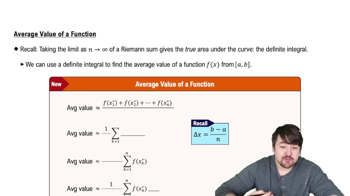
Average Value of a Function

Function Evaluation

Function evaluation involves substituting a specific value into a function to determine its output. For the given population function P(t) = 100t / (t + 1), evaluating it at t = 0 and t = 8 will yield the population sizes at these points. This step is essential for calculating the average rate of change over the specified interval.
Video consigliato:
Percorso guidato
4:26
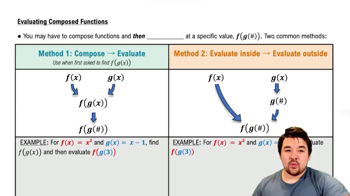
Evaluating Composed Functions

Continuous Functions

A continuous function is one that does not have any breaks, jumps, or holes in its graph over its domain. The function P(t) = 100t / (t + 1) is continuous for t ≥ 0, which ensures that the average rate of change can be accurately calculated over the interval [0, 8]. Understanding continuity is important for applying the Mean Value Theorem and other calculus concepts.
Video consigliato:
05:34
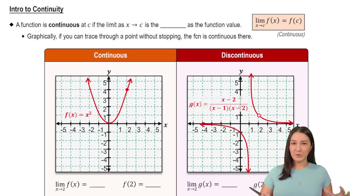
Intro to Continuity
Pratica correlata
Domanda del libro di testo

Travel costs A simple model for travel costs involves the cost of gasoline and the cost of a driver. Specifically, assume gasoline costs $p/gallon and the vehicle gets g miles per gallon. Also assume the driver earns $w/hour.


e. Should the optimal speed be increased or decreased (compared with part (d)) if L is increased from 400 mi to 500 mi? Explain.

248
views
Domanda del libro di testo

Mean Value Theorem The population of a culture of cells grows according to the function P(t) = 100t / t+1, where t ≥ 0 is measured in weeks.


b. At what point of the interval [0, 8] is the instantaneous rate of change equal to the average rate of change?

183
views
Domanda del libro di testo

Growth rate of bamboo Bamboo belongs to the grass family and is one of the fastest growing plants in the world.


a. A bamboo shoot was 500 cm tall at 10:00 A.M. and 515 cm tall at 3:00 P.M. Compute the average growth rate of the bamboo shoot in cm/hr over the period of time from 10:00 A.M. to 3:00 P.M.

210
views
Domanda del libro di testo

First Derivative Test


a. Locate the critical points of f.

b. Use the First Derivative Test to locate the local maximum and minimum values.

c. Identify the absolute maximum and minimum values of the function on the given interval (when they exist).


f(x) = x - 2 tan⁻¹ x on [-√3,√3)

154
views
Domanda del libro di testo

First Derivative Test


a. Locate the critical points of f.

b. Use the First Derivative Test to locate the local maximum and minimum values.

c. Identify the absolute maximum and minimum values of the function on the given interval (when they exist).


f(x) = x²/(x² - 1) on [-4,4]

148
views
Domanda del libro di testo

First Derivative Test


a. Locate the critical points of f.

b. Use the First Derivative Test to locate the local maximum and minimum values.

c. Identify the absolute maximum and minimum values of the function on the given interval (when they exist).


f(x) = 2x⁵ - 5x⁴ - 10x³ + 4 on [-2,4]

234
views