Ch. 4 - Applications of the Derivative
Briggs - Calculus: Early Transcendentals 3rd Edition
Briggs3rd EditionCalculus: Early TranscendentalsISBN: 9780136847243Non è quello che usi tu?Cambia libro di testo
Capitolo 4, Problema 4.9.75

Particular antiderivatives For the following functions f, find the antiderivative F that satisfies the given condition.
f(x) = (3y + 5)/y; F(1) = 3. y > 0

Guida verificata passo dopo passo
1
Rewrite the function \( f(x) = \frac{3y + 5}{y} \) by simplifying the expression. Since \( y > 0 \), divide each term in the numerator by \( y \) to get \( f(y) = 3 + \frac{5}{y} \).
Set up the antiderivative \( F(y) \) by integrating \( f(y) \) with respect to \( y \): \( F(y) = \int \left(3 + \frac{5}{y}\right) \, dy \).
Split the integral into two parts: \( F(y) = \int 3 \, dy + \int \frac{5}{y} \, dy \).
Integrate each term separately: \( \int 3 \, dy = 3y \) and \( \int \frac{5}{y} \, dy = 5 \ln|y| \). So, \( F(y) = 3y + 5 \ln|y| + C \), where \( C \) is the constant of integration.
Use the initial condition \( F(1) = 3 \) to solve for \( C \). Substitute \( y = 1 \) into the expression for \( F(y) \) and set it equal to 3, then solve for \( C \).

Risposta video verificata per un problema simile:

Questa soluzione video è stata consigliata dai nostri tutor come utile per risolvere questo problema.
Durata del video:
3m

Concetti chiave

Ecco i concetti essenziali che devi comprendere per rispondere correttamente alla domanda.

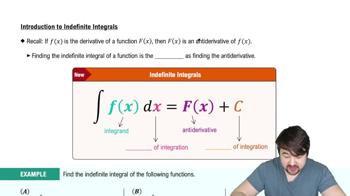
Antiderivative (Indefinite Integral)

An antiderivative of a function f(x) is another function F(x) whose derivative is f(x). Finding an antiderivative involves reversing differentiation, often using integration rules. The result includes a constant of integration since differentiation of a constant is zero.
Video consigliato:
Percorso guidato
05:04
Introduction to Indefinite Integrals

Initial Condition for Particular Solution

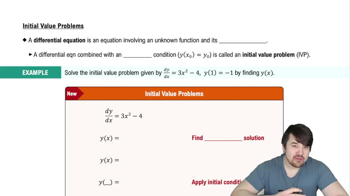
An initial condition like F(1) = 3 specifies the value of the antiderivative at a particular point. This condition allows us to determine the constant of integration, yielding a unique particular solution rather than a general family of functions.
Video consigliato:
Percorso guidato
05:03
Initial Value Problems

Integration of Rational Functions

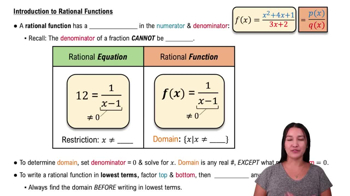
Integrating rational functions, such as (3y + 5)/y, often involves simplifying the expression by dividing terms or rewriting it as a sum of simpler fractions. This simplification makes it easier to apply basic integration rules to find the antiderivative.
Video consigliato:
6:04
Intro to Rational Functions