

Ch. 4 - Applications of the Derivative
Briggs - Calculus: Early Transcendentals 3rd Edition
Briggs3rd EditionCalculus: Early TranscendentalsISBN: 9780136847243Non è quello che usi tu?Cambia libro di testo
Capitolo 4, Problema 4.3.111c

Population models The population of a species is given by the function P(t) = Kt²/(t² + b) , where t ≥ 0 is measured in years and K and b are positive real numbers.


c. For arbitrary positive values of K and b, when does the maximum growth rate occur (in terms of K and b)?

Guida verificata passo dopo passo
1
To find when the maximum growth rate occurs, we need to determine the rate of change of the population, which is the derivative of the function P(t) with respect to time t. Start by finding the derivative P'(t) using the quotient rule.
The quotient rule states that if you have a function in the form of a quotient, u(t)/v(t), its derivative is given by (u'(t)v(t) - u(t)v'(t))/(v(t))^2. Here, u(t) = Kt² and v(t) = t² + b.
Calculate the derivatives: u'(t) = d/dt[Kt²] = 2Kt and v'(t) = d/dt[t² + b] = 2t.
Substitute these derivatives into the quotient rule formula to find P'(t): P'(t) = [(2Kt)(t² + b) - (Kt²)(2t)] / (t² + b)².
Simplify the expression for P'(t) and set it equal to zero to find the critical points. Solve for t to determine when the maximum growth rate occurs in terms of K and b.

Risposta video verificata per un problema simile:

Questa soluzione video è stata consigliata dai nostri tutor come utile per risolvere questo problema.
Durata del video:
8m

Concetti chiave

Ecco i concetti essenziali che devi comprendere per rispondere correttamente alla domanda.

Population Growth Rate

The population growth rate refers to the change in population size over time, often expressed as a derivative of the population function with respect to time. In this context, it is essential to find the derivative of the function P(t) to determine when the growth rate is maximized, which involves analyzing critical points where the derivative equals zero.
Video consigliato:
Percorso guidato
04:16
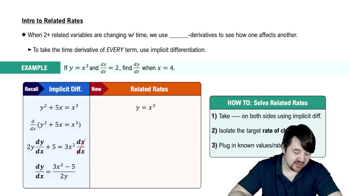
Intro To Related Rates

Critical Points

Critical points are values of the independent variable (in this case, time t) where the derivative of a function is either zero or undefined. These points are crucial for identifying local maxima and minima in the population growth function, as they indicate where the growth rate changes direction, helping to determine when the maximum growth occurs.
Video consigliato:
04:50
Critical Points

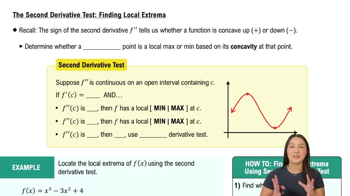
Second Derivative Test

The second derivative test is a method used to classify critical points as local maxima, minima, or points of inflection. By evaluating the second derivative of the population function at the critical points found, one can confirm whether the growth rate is at a maximum, providing insight into the behavior of the population over time.
Video consigliato:
06:02
The Second Derivative Test: Finding Local Extrema
Pratica correlata
Domanda del libro di testo

{Use of Tech} Fixed points of quadratics and quartics Let f(x) = ax(1 -x), where a is a real number and 0 ≤ a ≤ 1. Recall that the fixed point of a function is a value of x such that f(x) = x (Exercises 48–51). 


d. Find the number and location of the fixed points of g for a = 2, 3, and 4 on the interval 0 ≤ x ≤ 1. 

256
views
Domanda del libro di testo

if ƒ(x) = 1 / (3x⁴ + 5) , it can be shown that ƒ'(x) = 12x³ / (3x⁴ + 5)² and ƒ"(x) = 180x² (x² + 1) (x + 1) (x - 1) / (3x⁴ + 5)³ . Use these functions to complete the following steps.


d. Identify the local extreme values and inflection points of ƒ .

244
views
Domanda del libro di testo

{Use of Tech} Elliptic curves The equation y² = x³ - ax + 3, where a is a parameter, defines a well-known family of elliptic curves.


c. By experimentation, determine the approximate value of a (3 < a < 4)at which the graph separates into two curves.

263
views
Domanda del libro di testo

107–110. {Use of Tech} Motion with gravity Consider the following descriptions of the vertical motion of an object subject only to the acceleration due to gravity. Begin with the acceleration equation a(t) = v' (t) = -g , where g = 9.8 m/s² .

c. Find the time when the object reaches its highest point. What is the height? 

A payload is released at an elevation of 400 m from a hot-air balloon that is rising at a rate of 10 m/s.

50
views
Domanda del libro di testo

Sketch a graph of a function f with the following properties.


f' < 0 and f" < 0, for 8 < x < 10

264
views
Domanda del libro di testo

{Use of Tech} Fixed points of quadratics and quartics Let f(x) = ax(1 -x), where a is a real number and 0 ≤ a ≤ 1. Recall that the fixed point of a function is a value of x such that f(x) = x (Exercises 48–51). 


c. Graph g for a = 2, 3, and 4.

220
views