Ch. 4 - Applications of the Derivative
Briggs - Calculus: Early Transcendentals 3rd Edition
Briggs3rd EditionCalculus: Early TranscendentalsISBN: 9780136847243Non è quello che usi tu?Cambia libro di testo
Capitolo 4, Problema 119

Prove that lim_x→∞ (1 + a/x)ˣ = eᵃ , for a ≠ 0 .

Guida verificata passo dopo passo
1
Step 1: Begin by understanding the expression (1 + a/x)^x. As x approaches infinity, the term a/x approaches 0, making the expression resemble (1 + 0)^x, which is 1^x = 1. However, the limit involves a more subtle behavior due to the exponent x.
Step 2: To analyze the limit, take the natural logarithm of the expression: ln((1 + a/x)^x) = x * ln(1 + a/x). This transformation helps simplify the expression by bringing the exponent down.
Step 3: Use the approximation ln(1 + u) ≈ u for small values of u. Here, u = a/x, which is small as x approaches infinity. Therefore, ln(1 + a/x) ≈ a/x.
Step 4: Substitute the approximation into the expression: x * ln(1 + a/x) ≈ x * (a/x) = a. This shows that the logarithm of the original expression approaches a as x approaches infinity.
Step 5: Since the natural logarithm of the expression approaches a, the original expression (1 + a/x)^x approaches e^a, because the exponential function is the inverse of the natural logarithm. Therefore, lim_x→∞ (1 + a/x)^x = e^a.

Risposta video verificata per un problema simile:

Questa soluzione video è stata consigliata dai nostri tutor come utile per risolvere questo problema.
Durata del video:
5m

Concetti chiave

Ecco i concetti essenziali che devi comprendere per rispondere correttamente alla domanda.

Limits

In calculus, a limit describes the behavior of a function as its input approaches a certain value. In this case, we are interested in the limit as x approaches infinity. Understanding limits is crucial for analyzing the behavior of functions at extreme values and is foundational for concepts like continuity and derivatives.
Video consigliato:
05:50
One-Sided Limits

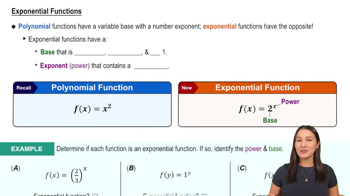
Exponential Functions

Exponential functions are mathematical functions of the form f(x) = e^x, where e is Euler's number (approximately 2.718). These functions are characterized by their constant growth rate, which is proportional to their current value. In the context of the limit, recognizing how the expression (1 + a/x)ˣ behaves as x increases is essential for proving the limit converges to eᵃ.
Video consigliato:
6:13
Exponential Functions

The Definition of e

Euler's number e is defined as the limit of (1 + 1/n)ⁿ as n approaches infinity. This definition is fundamental in calculus and helps establish the relationship between exponential growth and limits. In the given limit, we can manipulate the expression to resemble this definition, allowing us to prove that lim_x→∞ (1 + a/x)ˣ converges to eᵃ.
Video consigliato:
Percorso guidato
05:43
Definition of the Definite Integral