
Ch. 4 - Applications of the Derivative
Briggs - Calculus: Early Transcendentals 3rd Edition
Briggs3rd EditionCalculus: Early TranscendentalsISBN: 9780136847243Non è quello che usi tu?Cambia libro di testo
Capitolo 4, Problema 4.8.37c

{Use of Tech} A damped oscillator The displacement of an object as it bounces vertically up and down on a spring is given by y(t) = 2.5e⁻ᵗ cos 2t, where the initial displacement is y(0) = 2.5 and y = 0 corresponds to the rest position (see figure). <IMAGE>


c. Find the time at which the object passes the rest position for the second time.

Guida verificata passo dopo passo
1
First, understand the function y(t) = 2.5e⁻ᵗ cos 2t. This represents a damped oscillator, where the term 2.5e⁻ᵗ is the damping factor and cos 2t is the oscillatory component.
To find when the object passes the rest position, set y(t) = 0 and solve for t. This means solving the equation 2.5e⁻ᵗ cos 2t = 0.
Since 2.5e⁻ᵗ is never zero for any real value of t, focus on the oscillatory part: cos 2t = 0. The cosine function is zero at odd multiples of π/2, so set 2t = (2n+1)π/2, where n is an integer.
Solve for t: t = (2n+1)π/4. This gives the times at which the object passes the rest position.
To find the second time the object passes the rest position, use n = 1 (since n = 0 corresponds to the first time). Substitute n = 1 into the equation t = (2n+1)π/4 to find the second time.

Risposta video verificata per un problema simile:

Questa soluzione video è stata consigliata dai nostri tutor come utile per risolvere questo problema.
Durata del video:
5m

Concetti chiave

Ecco i concetti essenziali che devi comprendere per rispondere correttamente alla domanda.

Damped Oscillator

A damped oscillator is a system in which the amplitude of oscillation decreases over time due to energy loss, often modeled by an exponential decay function. In the given equation, the term '2.5e⁻ᵗ' represents this damping effect, indicating that the displacement diminishes as time progresses.
Video consigliato:
03:07
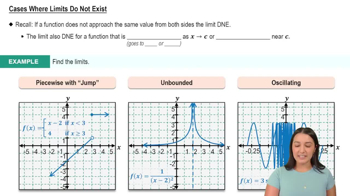
Cases Where Limits Do Not Exist

Cosine Function in Oscillations

The cosine function is fundamental in describing periodic motion, such as oscillations. In the equation y(t) = 2.5e⁻ᵗ cos 2t, the 'cos 2t' component indicates the oscillatory behavior of the system, with '2' representing the angular frequency, which affects the speed of oscillation.
Video consigliato:
Percorso guidato
5:53
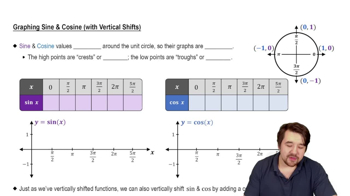
Graph of Sine and Cosine Function

Finding Roots of the Function

To determine when the object passes the rest position (y = 0), we need to find the roots of the function y(t). This involves solving the equation 2.5e⁻ᵗ cos 2t = 0, which occurs when cos 2t = 0, leading to specific values of t that correspond to the times the object crosses the rest position.
Video consigliato:
05:21
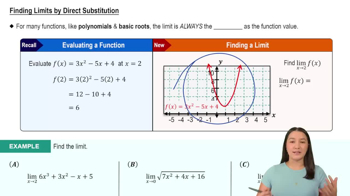
Finding Limits by Direct Substitution
Pratica correlata
Domanda del libro di testo

107–110. {Use of Tech} Motion with gravity Consider the following descriptions of the vertical motion of an object subject only to the acceleration due to gravity. Begin with the acceleration equation a(t) = v' (t) = -g , where g = 9.8 m/s² .

b. Find the position of the object for all relevant times. 

A payload is released at an elevation of 400 m from a hot-air balloon that is rising at a rate of 10 m/s.

43
views
Domanda del libro di testo

Suppose S = x + 2y is an objective function subject to the constraint xy = 50, for x > 0 and y > 0.

b. Find the absolute minimum value of S subject to the given constraint.

283
views
Domanda del libro di testo

{Use of Tech} Elliptic curves The equation y² = x³ - ax + 3, where a is a parameter, defines a well-known family of elliptic curves.


c. By experimentation, determine the approximate value of a (3 < a < 4)at which the graph separates into two curves.

263
views
Domanda del libro di testo

{Use of Tech} Fixed points of quadratics and quartics Let f(x) = ax(1 -x), where a is a real number and 0 ≤ a ≤ 1. Recall that the fixed point of a function is a value of x such that f(x) = x (Exercises 48–51). 


c. Graph g for a = 2, 3, and 4.

220
views
Domanda del libro di testo

Cylinder in a cone A right circular cylinder is placed inside a cone of radius R and height H so that the base of the cylinder lies on the base of the cone.


b. Find the dimensions of the cylinder with maximum lateral surface area (area of the curved surface).

389
views
Domanda del libro di testo

Explain why or why not Determine whether the following statements are true and give an explanation or counterexample.


c. If f(x) = mx + b, then the linear approximation to f at any point is L(x) = f(x).

186
views