Ch. 4 - Applications of the Derivative
Briggs - Calculus: Early Transcendentals 3rd Edition
Briggs3rd EditionCalculus: Early TranscendentalsISBN: 9780136847243Non è quello che usi tu?Cambia libro di testo
Capitolo 4, Problema 4.26.1

{Use of Tech} Finding all roots Use Newton’s method to find all the roots of the following functions. Use preliminary analysis and graphing to determine good initial approximations.


f(x) = x²(x - 100) + 1

Guida verificata passo dopo passo
1
Start by analyzing the function f(x) = x²(x - 100) + 1. Notice that it is a cubic polynomial, which means it can have up to three real roots. The term x²(x - 100) suggests that the roots might be around x = 0 and x = 100.
Graph the function f(x) to visually inspect where the roots might be located. Look for points where the graph crosses the x-axis, as these indicate potential roots. This will help you choose good initial approximations for Newton's method.
Choose initial approximations based on the graph. For example, if the graph suggests roots near x = 0 and x = 100, you might start with x₀ = 0 and x₀ = 100. If the graph shows another crossing point, choose an initial approximation near that point as well.
Apply Newton's method, which uses the formula xₙ₊₁ = xₙ - f(xₙ) / f'(xₙ). First, find the derivative f'(x) of the function f(x). For f(x) = x²(x - 100) + 1, use the product rule and power rule to differentiate.
Iterate using Newton's method: Calculate x₁ using your initial approximation x₀, then use x₁ to find x₂, and so on, until the values converge to a stable root. Repeat this process for each initial approximation to find all roots.

Risposta video verificata per un problema simile:

Questa soluzione video è stata consigliata dai nostri tutor come utile per risolvere questo problema.
Durata del video:
5m

Concetti chiave

Ecco i concetti essenziali che devi comprendere per rispondere correttamente alla domanda.

Newton's Method

Newton's Method is an iterative numerical technique used to find approximate roots of a real-valued function. It starts with an initial guess and refines it using the formula x_{n+1} = x_n - f(x_n)/f'(x_n), where f' is the derivative of f. This method converges quickly if the initial guess is close to the actual root, making it effective for functions that are differentiable.
Video consigliato:
Percorso guidato
4:26
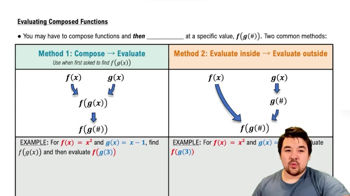
Evaluating Composed Functions

Preliminary Analysis

Preliminary analysis involves examining the function's behavior to identify potential roots before applying numerical methods. This includes evaluating the function at various points, checking for sign changes, and analyzing critical points and asymptotes. This step helps in selecting good initial approximations for Newton's Method, increasing the likelihood of convergence.
Video consigliato:
Percorso guidato
06:29
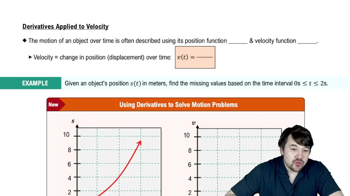
Derivatives Applied To Velocity

Graphing Functions

Graphing functions provides a visual representation of their behavior, helping to identify roots, intercepts, and overall trends. By plotting the function, one can observe where it crosses the x-axis, indicating potential roots. This visual approach complements analytical methods and aids in selecting effective starting points for iterative methods like Newton's.
Video consigliato:
Percorso guidato
5:53
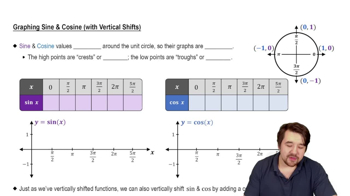
Graph of Sine and Cosine Function