
Ch. 4 - Applications of the Derivative
Briggs - Calculus: Early Transcendentals 3rd Edition
Briggs3rd EditionCalculus: Early TranscendentalsISBN: 9780136847243Non è quello che usi tu?Cambia libro di testo
Capitolo 4, Problema 58

{Use of Tech} Flow from a tank A cylindrical tank is full at time t=0 when a valve in the bottom of the tank is opened. By Torricelli’s law, the volume of water in the tank after t hours is V=100(200−t)², measured in cubic meters.
c. Find the rate at which water flows from the tank and plot the flow rate function. 

Guida verificata passo dopo passo
1
Step 1: Understand the problem. We need to find the rate at which water flows from the tank. This is the derivative of the volume function V with respect to time t, which gives us the flow rate function.
Step 2: Identify the volume function. The volume of water in the tank at time t is given by V(t) = 100(200 - t)^2.
Step 3: Differentiate the volume function with respect to time t. Use the chain rule to find the derivative of V(t). The chain rule states that if you have a composite function, the derivative is the derivative of the outer function evaluated at the inner function times the derivative of the inner function.
Step 4: Apply the chain rule. Let u = 200 - t, then V(t) = 100u^2. The derivative of V with respect to u is 200u, and the derivative of u with respect to t is -1. Therefore, the derivative of V with respect to t is dV/dt = 200u * (-1).
Step 5: Substitute back the expression for u. Since u = 200 - t, substitute this back into the derivative to get the flow rate function: dV/dt = -200(200 - t). This function represents the rate at which water flows from the tank.

Risposta video verificata per un problema simile:

Questa soluzione video è stata consigliata dai nostri tutor come utile per risolvere questo problema.
Durata del video:
6m

Concetti chiave

Ecco i concetti essenziali che devi comprendere per rispondere correttamente alla domanda.

Torricelli's Law

Torricelli's Law states that the speed of fluid flowing out of an orifice under the force of gravity is proportional to the square root of the height of the fluid above the opening. This principle is crucial for understanding how the volume of water in a tank changes over time, as it relates the height of the water to the flow rate.

Volume Function

The volume function V(t) = 100(200−t)² describes how the volume of water in the tank decreases over time. Understanding this function is essential for determining the flow rate, as it provides the relationship between time and the remaining volume of water in the tank.
Video consigliato:
Percorso guidato
06:21
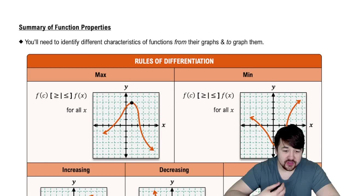
Properties of Functions

Derivative and Rate of Change

The derivative of a function represents the rate of change of that function with respect to its variable. In this context, finding the derivative of the volume function V(t) will yield the flow rate of water leaving the tank, which is a key aspect of solving the problem.
Video consigliato:
Percorso guidato
04:16
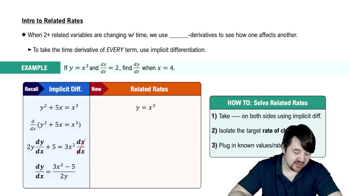
Intro To Related Rates
Pratica correlata
Domanda del libro di testo

{Use of Tech} Approximating reciprocals To approximate the reciprocal of a number a without using division, we can apply Newton’s method to the function f(x) = 1/x - a. 

b. Apply Newton’s method with a = 7 using a starting value of your choice. Compute an approximation with eight digits of accuracy. What number does Newton’s method approximate in this case?  

223
views
Domanda del libro di testo

{Use of Tech} Modified Newton’s method The function f has a root of multiplicity 2 at r if f(r) = f'(r) = 0 and f"(r) ≠ 0. In this case, a slight modification of Newton’s method, known as the modified (or accelerated) Newton’s method, is given by the formula xₙ + 1 = xₙ - (2f(xₙ)/(f'(xₙ), for n = 0, 1, 2, . . . . This modified form generally increases the rate of convergence.

b. Apply Newton’s method and the modified Newton’s method using x₀ = 0.1 to find the value of x₃ in each case. Compare the accuracy of these values of x₃.

274
views
Domanda del libro di testo

Minimizing related functions Complete each of the following parts.

b. What value of x minimizes ƒ(x) = (x- a₁)² + (x - a₂)² + (x - a₃)² , for constants a₁, a₂, and a₃?

258
views
Domanda del libro di testo

Verify that the following functions satisfy the conditions of Theorem 4.9 on their domains. Then find the location and value of the absolute extrema guaranteed by the theorem.


f(x) = 4x + 1/√x

257
views
Domanda del libro di testo

Evaluate the following limits. Use l’Hôpital’s Rule when it is convenient and applicable.

lim_x→1⁻ (x/(x-1) - x/(ln x) 

219
views
Domanda del libro di testo

Evaluate the following limits in two different ways: with and without l’Hôpital’s Rule.

lim_x→∞ (2x⁵ - x + 1) / (5x⁶ + x)

287
views