Ch. 4 - Applications of the Derivative
Briggs - Calculus: Early Transcendentals 3rd Edition
Briggs3rd EditionCalculus: Early TranscendentalsISBN: 9780136847243Non è quello che usi tu?Cambia libro di testo
Capitolo 4, Problema 4.8.45

{Use of Tech} Newton’s method and curve sketching Use Newton’s method to find approximate answers to the following questions.
Where are the inflection points of f(x) = (9/5)x⁵ - (15/2)x⁴ + (7/3)x³ + 30x² + 1 located?

Guida verificata passo dopo passo
1
To find the inflection points of the function \( f(x) = \frac{9}{5}x^5 - \frac{15}{2}x^4 + \frac{7}{3}x^3 + 30x^2 + 1 \), we first need to find the second derivative, \( f''(x) \).
Calculate the first derivative \( f'(x) \) by differentiating \( f(x) \): \( f'(x) = \frac{d}{dx}\left(\frac{9}{5}x^5 - \frac{15}{2}x^4 + \frac{7}{3}x^3 + 30x^2 + 1\right) \).
Differentiate \( f'(x) \) to find the second derivative \( f''(x) \). This involves applying the power rule to each term of \( f'(x) \).
Set \( f''(x) = 0 \) to find potential inflection points. Solve this equation to find the critical points where the concavity might change.
Use Newton's method to approximate the roots of \( f''(x) = 0 \). Start with an initial guess \( x_0 \) and iterate using the formula \( x_{n+1} = x_n - \frac{f''(x_n)}{f'''(x_n)} \) until the values converge to a satisfactory level of precision.

Risposta video verificata per un problema simile:

Questa soluzione video è stata consigliata dai nostri tutor come utile per risolvere questo problema.
Durata del video:
11m

Concetti chiave

Ecco i concetti essenziali che devi comprendere per rispondere correttamente alla domanda.

Newton's Method

Newton's Method is an iterative numerical technique used to find approximate solutions to equations, particularly for finding roots of functions. It utilizes the function's derivative to refine guesses, starting from an initial estimate. The method is effective for functions that are continuous and differentiable, allowing for rapid convergence to a solution when the initial guess is close enough.
Video consigliato:
Percorso guidato
4:26
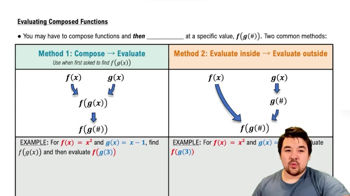
Evaluating Composed Functions

Inflection Points

Inflection points are points on a curve where the concavity changes, indicating a shift in the direction of curvature. To find inflection points, one must compute the second derivative of the function and determine where it equals zero or is undefined. These points are significant in curve sketching as they help identify changes in the behavior of the graph, such as transitions from concave up to concave down.
Video consigliato:
04:50
Critical Points

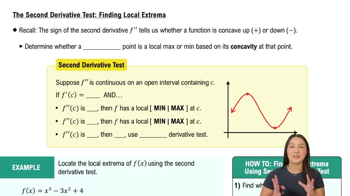
Second Derivative Test

The Second Derivative Test is a method used to classify critical points of a function by analyzing the sign of the second derivative. If the second derivative is positive at a critical point, the function is concave up, indicating a local minimum; if negative, it indicates a local maximum. If the second derivative is zero, the test is inconclusive, and further analysis is needed to determine the nature of the critical point.
Video consigliato:
06:02
The Second Derivative Test: Finding Local Extrema