Ch. 5 - Integration
Briggs - Calculus: Early Transcendentals 3rd Edition
Briggs3rd EditionCalculus: Early TranscendentalsISBN: 9780136847243Non è quello che usi tu?Cambia libro di testo
Capitolo 5, Problema 5.3.14g

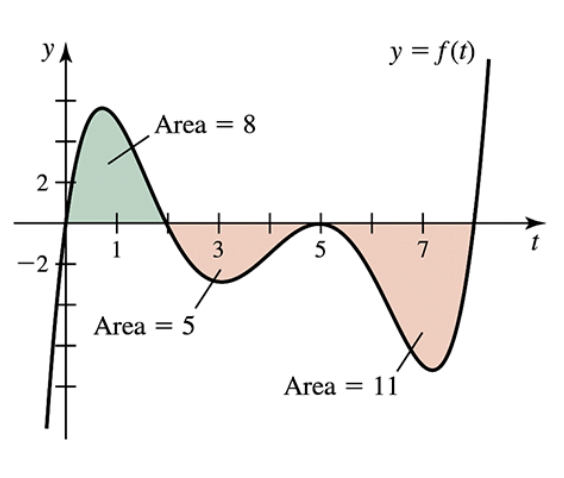
Area functions The graph of ƒ is shown in the figure. Let A(x) = ∫₀ˣ ƒ(t) dt and F(x) = ∫₂ˣ ƒ(t) dt be two area functions for ƒ. Evaluate the following area functions.
(g) F(2)
Graph of a function with labeled areas: green area = 8, red areas = 5 and 11, illustrating integral concepts.

Guida verificata passo dopo passo
1
Step 1: Understand the problem. We are tasked with evaluating F(2), where F(x) = ∫₂ˣ ƒ(t) dt. This represents the net area under the curve of ƒ(t) from t = 2 to t = x. Specifically, F(2) means evaluating the integral from t = 2 to t = 2.
Step 2: Recall a key property of definite integrals. When the upper and lower limits of integration are the same, the integral evaluates to 0. Mathematically, ∫ₐₐ ƒ(t) dt = 0 for any function ƒ(t).
Step 3: Apply this property to the given function. Since the limits of integration for F(2) are both 2, the integral simplifies to 0.
Step 4: Confirm this result conceptually. No area is enclosed when the start and end points of integration are identical, so the net area is 0.
Step 5: Conclude that F(2) = 0 based on the properties of definite integrals and the graph provided.

Risposta video verificata per un problema simile:

Questa soluzione video è stata consigliata dai nostri tutor come utile per risolvere questo problema.
Durata del video:
1m

Concetti chiave

Ecco i concetti essenziali che devi comprendere per rispondere correttamente alla domanda.

Definite Integral

A definite integral represents the signed area under a curve between two points on the x-axis. It is calculated using the Fundamental Theorem of Calculus, which connects differentiation and integration. In this context, the area functions A(x) and F(x) are defined as integrals of the function f(t) over specified intervals, allowing us to compute the total area accumulated from the lower limit to x.
Video consigliato:
Percorso guidato
05:43
Definition of the Definite Integral

Area Function

An area function, such as A(x) or F(x), quantifies the area under the curve of a function f(t) from a starting point to a variable endpoint x. For example, A(x) = ∫₀ˣ f(t) dt calculates the area from 0 to x, while F(x) = ∫₂ˣ f(t) dt starts from 2. These functions are useful for evaluating how the area changes as x varies, providing insights into the behavior of the function.
Video consigliato:
05:06
Finding Area When Bounds Are Not Given

Signed Area

Signed area refers to the concept that areas above the x-axis are considered positive, while areas below the x-axis are negative. This distinction is crucial when calculating definite integrals, as it affects the total area value. In the provided graph, the green area (8) is positive, while the red areas (5 and 11) are negative, which will influence the evaluation of the area functions F(2) and A(x) based on the intervals considered.
Video consigliato:
05:06
Finding Area When Bounds Are Not Given
Pratica correlata
Domanda del libro di testo

Sigma notation Evaluate the following expressions.                                                                                                                                          

  (f)      3                                                                                                                                                                               

       ∑ (3j ― 4)                                                                                                                                                                          

      j =1                         

83
views

Domanda del libro di testo

Properties of integrals Consider two functions ƒ and g on [1,6] such that ∫₁⁶ƒ(𝓍) d𝓍 = 10 and ∫₁⁶g(𝓍) d𝓍 = 5, ∫₄⁶ƒ(𝓍) d𝓍 = 5 , and ∫₁⁴g(𝓍) d𝓍 = 2. Evaluate the following integrals.


(f) ∫₄¹ 2f(𝓍) d𝓍

49
views
Domanda del libro di testo

Use Table 5.6 to evaluate the following indefinite integrals.                                                                                                               


 (f) ∫ d𝓍/√36 ―𝓍²

78
views