Ch. 5 - Integration
Briggs - Calculus: Early Transcendentals 3rd Edition
Briggs3rd EditionCalculus: Early TranscendentalsISBN: 9780136847243Non è quello che usi tu?Cambia libro di testo
Capitolo 5, Problema 5.2.29

Area versus net area Graph the following functions. Then use geometry (not Riemann sums) to find the area and the net area of the region described.
The region between the graph of y = 1 - |x| and the x-axis, for -2 ≤ x ≤ 2

Guida verificata passo dopo passo
1
First, understand the function given: \(y = 1 - |x|\). This is a V-shaped graph with its vertex at \((0,1)\) and it intersects the x-axis where \(1 - |x| = 0\).
Find the points where the graph intersects the x-axis by solving \(1 - |x| = 0\). This gives \(|x| = 1\), so the points are \(x = -1\) and \(x = 1\).
Sketch the graph between \(x = -2\) and \(x = 2\). Note that for \(|x| > 1\), the function \(y = 1 - |x|\) is negative, so the graph lies below the x-axis on the intervals \([-2, -1]\) and \([1, 2]\), and above the x-axis on \([-1, 1]\).
To find the net area, calculate the definite integral of \(y = 1 - |x|\) from \(-2\) to \(2\). Since the function changes sign, the net area is the sum of the positive area above the x-axis minus the area below the x-axis.
To find the total (or geometric) area, calculate the area of the two triangles formed above the x-axis on \([-1, 1]\) and the two triangles below the x-axis on \([-2, -1]\) and \([1, 2]\), then add their absolute values together.

Risposta video verificata per un problema simile:

Questa soluzione video è stata consigliata dai nostri tutor come utile per risolvere questo problema.
Durata del video:
4m

Concetti chiave

Ecco i concetti essenziali che devi comprendere per rispondere correttamente alla domanda.

Net Area

Net area refers to the integral of a function over an interval, accounting for areas above the x-axis as positive and below as negative. It represents the algebraic sum of areas, which can result in cancellation when parts lie below the x-axis.
Video consigliato:
05:06
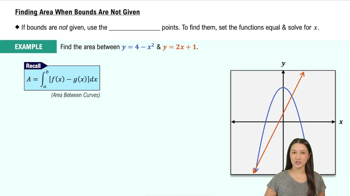
Finding Area When Bounds Are Not Given

Area Between a Curve and the x-axis

The area between a curve and the x-axis is the total size of the region bounded by the graph and the axis, always taken as positive. When the function dips below the x-axis, the area is found by integrating the absolute value or by geometric methods considering separate regions.
Video consigliato:
05:23
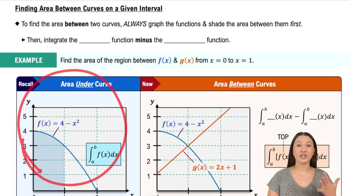
Finding Area Between Curves on a Given Interval

Using Geometry to Find Areas

Instead of integration, geometric shapes like triangles and trapezoids can be used to find areas under curves when the graph forms simple shapes. This approach involves identifying shapes formed by the function and the x-axis and calculating their areas using known formulas.
Video consigliato:
05:06
Finding Area When Bounds Are Not Given
Pratica correlata
Domanda del libro di testo

Indefinite integrals Use a change of variables or Table 5.6 to evaluate the following indefinite integrals. Check your work by differentiating.                                                                                  


 ∫ [(√𝓍 + 1)⁴ / 2√𝓍 d𝓍

65
views

Domanda del libro di testo

Average values Find the average value of the following functions on the given interval. Draw a graph of the function and indicate the average value.

ƒ(𝓍) = 𝓍ⁿ on [0,1] , for any positive integer n

87
views
Domanda del libro di testo

Average values Find the average value of the following functions on the given interval. Draw a graph of the function and indicate the average value.

ƒ(𝓍) = 𝓍³ on [―1, 1]

125
views
Domanda del libro di testo

Definite integrals from graphs The figure shows the areas of regions bounded by the graph of ƒ and the 𝓍-axis. Evaluate the following integrals.


∫ₐ⁰ ƒ(𝓍) d𝓍

71
views
Domanda del libro di testo

Variations on the substitution method Evaluate the following integrals.                                                                                                        


 ∫ (eˣ ― e⁻ˣ)/ (eˣ + e⁻ˣ) d𝓍

42
views
Domanda del libro di testo

Identifying Riemann sums Fill in the blanks with an interval and a value of n.


4

∑ ƒ (1 + k) • 1 is a right Riemann sum for f on the interval [ ___ , ___ ] with

k = 1

n = ________ .

101
views