Ch. 5 - Integration
Briggs - Calculus: Early Transcendentals 3rd Edition
Briggs3rd EditionCalculus: Early TranscendentalsISBN: 9780136847243Non è quello che usi tu?Cambia libro di testo
Capitolo 5, Problema 5.4.56

Average value of the derivative Suppose ƒ ' is a continuous function for all real numbers. Show that the average value of the derivative on an interval [a, b] is ƒ⁻' = (ƒ(b) ―ƒ(a))/ (b―a) . Interpret this result in terms of secant lines.

Guida verificata passo dopo passo
1
Step 1: Recall the Mean Value Theorem (MVT) for derivatives, which states that if a function ƒ is continuous on [a, b] and differentiable on (a, b), then there exists a point c in (a, b) such that ƒ'(c) = (ƒ(b) - ƒ(a)) / (b - a). This theorem provides the foundation for the average value of the derivative.
Step 2: Define the average value of the derivative over the interval [a, b]. The average value of ƒ'(x) on [a, b] is given by the integral formula: (1 / (b - a)) ∫[a, b] ƒ'(x) dx. This formula calculates the mean rate of change of the function over the interval.
Step 3: Apply the Fundamental Theorem of Calculus to the integral ∫[a, b] ƒ'(x) dx. According to this theorem, the integral of the derivative of a function over an interval is equal to the net change in the function over that interval: ∫[a, b] ƒ'(x) dx = ƒ(b) - ƒ(a).
Step 4: Substitute the result from Step 3 into the average value formula. Replace ∫[a, b] ƒ'(x) dx with ƒ(b) - ƒ(a) to get: (1 / (b - a)) ∫[a, b] ƒ'(x) dx = (ƒ(b) - ƒ(a)) / (b - a). This shows that the average value of the derivative is equal to the slope of the secant line connecting the points (a, ƒ(a)) and (b, ƒ(b)).
Step 5: Interpret the result in terms of secant lines. The average value of the derivative on [a, b] represents the slope of the secant line between the endpoints of the interval. This means that the average rate of change of the function over the interval is equivalent to the slope of the straight line connecting the points (a, ƒ(a)) and (b, ƒ(b)) on the graph of ƒ.

Risposta video verificata per un problema simile:

Questa soluzione video è stata consigliata dai nostri tutor come utile per risolvere questo problema.
Durata del video:
2m

Concetti chiave

Ecco i concetti essenziali che devi comprendere per rispondere correttamente alla domanda.

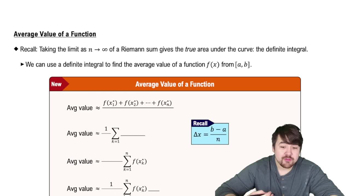
Average Value of a Function

The average value of a function over an interval [a, b] is defined as the integral of the function over that interval divided by the length of the interval. For a continuous function f, this is expressed mathematically as (1/(b-a)) * ∫[a to b] f(x) dx. This concept is crucial for understanding how the behavior of a function can be summarized over a specific range.
Video consigliato:
Percorso guidato
06:37
Average Value of a Function

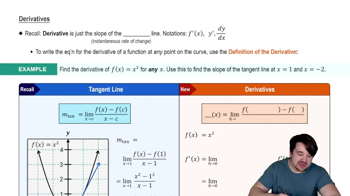
Derivative and Its Interpretation

The derivative of a function at a point measures the rate of change of the function with respect to its variable. It is represented as f'(x) and can be interpreted as the slope of the tangent line to the curve at that point. Understanding derivatives is essential for analyzing how functions behave locally and for connecting to the concept of average rates of change over intervals.
Video consigliato:

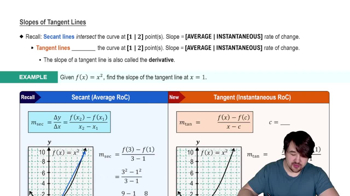
Secant Lines

A secant line is a straight line that connects two points on a curve, representing the average rate of change of the function between those two points. The slope of the secant line between points (a, f(a)) and (b, f(b)) is given by (f(b) - f(a)) / (b - a). This concept helps visualize the average value of the derivative, as the slope of the secant line approximates the derivative as the interval narrows.
Video consigliato:
Percorso guidato
05:13
Slopes of Tangent Lines
Pratica correlata
Domanda del libro di testo

Indefinite integrals Use a change of variables or Table 5.6 to evaluate the following indefinite integrals. Check your work by differentiating.                                                                                  


 ∫ sec 4w tan 4w dw

55
views

Domanda del libro di testo

Symmetry in integrals Use symmetry to evaluate the following integrals.

∫²₋₂ [(x³ ― 4x) / (x² + 1)] dx 

134
views
Domanda del libro di testo

Definite integrals Use a change of variables or Table 5.6 to evaluate the following definite integrals.                                                                                                                         


 ∫₀^π/⁴ eˢᶦⁿ² ˣ sin 2𝓍 d𝓍

104
views
Domanda del libro di testo

Definite integrals from graphs The figure shows the areas of regions bounded by the graph of ƒ and the 𝓍-axis. Evaluate the following integrals.


∫₀ᵃ ƒ(𝓍) d𝓍

57
views
Domanda del libro di testo

General results Evaluate the following integrals in which the function ƒ is unspecified. Note that ƒ⁽ᵖ⁾ is the pth derivative of ƒ and ƒᵖ is the pth power of ƒ. Assume ƒ and its derivatives are continuous for all real numbers. 

∫ (5 ƒ³ (𝓍) + 7ƒ² (𝓍) + ƒ (𝓍 )) ƒ'(𝓍) d𝓍

85
views
Domanda del libro di testo

Indefinite integrals Use a change of variables or Table 5.6 to evaluate the following indefinite integrals. Check your work by differentiating.                                                                                  


 ∫ (sin⁵ 𝓍 + 3 sin³ 𝓍― sin 𝓍) cos 𝓍 d𝓍

74
views