

Ch. 5 - Integration
Briggs - Calculus: Early Transcendentals 3rd Edition
Briggs3rd EditionCalculus: Early TranscendentalsISBN: 9780136847243Non è quello che usi tu?Cambia libro di testo
Capitolo 5, Problema 5.3.55

Definite integrals Evaluate the following integrals using the Fundamental Theorem of Calculus


∫π/₄^³π/⁴ (cot² 𝓍 + 1) d𝓍

Guida verificata passo dopo passo
1
Step 1: Recognize that the integral ∫π/₄^³π/⁴ (cot² 𝓍 + 1) d𝓍 can be simplified using trigonometric identities. Recall that cot²(𝓍) + 1 = csc²(𝓍). This simplifies the integral to ∫π/₄^³π/⁴ csc²(𝓍) d𝓍.
Step 2: Identify the antiderivative of csc²(𝓍). The antiderivative of csc²(𝓍) is -cot(𝓍). Using this, rewrite the integral as [-cot(𝓍)] evaluated from π/4 to 3π/4.
Step 3: Apply the Fundamental Theorem of Calculus. Substitute the upper limit (𝓍 = 3π/4) and the lower limit (𝓍 = π/4) into the antiderivative -cot(𝓍). This gives -cot(3π/4) - (-cot(π/4)).
Step 4: Simplify the expression. Use the unit circle or trigonometric properties to evaluate cot(3π/4) and cot(π/4). Recall that cot(π/4) = 1 and cot(3π/4) = -1.
Step 5: Combine the results from the previous step to find the value of the definite integral. This involves subtracting the evaluated terms from Step 4.

Risposta video verificata per un problema simile:

Questa soluzione video è stata consigliata dai nostri tutor come utile per risolvere questo problema.
Durata del video:
2m

Concetti chiave

Ecco i concetti essenziali che devi comprendere per rispondere correttamente alla domanda.

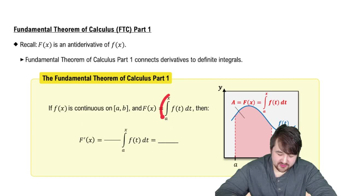
Fundamental Theorem of Calculus

The Fundamental Theorem of Calculus links the concept of differentiation with integration, stating that if a function is continuous on an interval [a, b], then the integral of its derivative over that interval equals the difference in the values of the function at the endpoints. This theorem allows us to evaluate definite integrals by finding an antiderivative of the integrand.
Video consigliato:
Percorso guidato
06:11
Fundamental Theorem of Calculus Part 1

Definite Integral

A definite integral represents the signed area under a curve defined by a function over a specific interval [a, b]. It is calculated using the limits of integration, which specify the interval, and provides a numerical value that reflects the accumulation of quantities, such as area, over that interval.
Video consigliato:
Percorso guidato
05:43
Definition of the Definite Integral

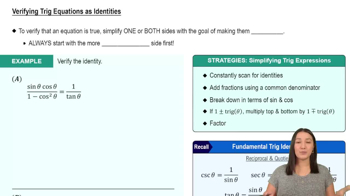
Trigonometric Identities

Trigonometric identities are equations involving trigonometric functions that hold true for all values of the variables involved. In the context of the given integral, recognizing that cot² x + 1 equals csc² x can simplify the integration process, making it easier to evaluate the integral by transforming it into a more manageable form.
Video consigliato:
7:17
Verifying Trig Equations as Identities
Pratica correlata
Domanda del libro di testo

Displacement from velocity The following functions describe the velocity of a car (in mi/hr) moving along a straight highway for a 3-hr interval. In each case, find the function that gives the displacement of the car over the interval [0,t], where 0 ≤ t ≤ 3.

v(t) = { 30 if 0 ≤ t ≤ 2

50 if 2 < t < 2.5

44 if 2.5 < t ≤ 3

98
views
Domanda del libro di testo

Definite integrals Use geometry (not Riemann sums) to evaluate the following definite integrals. Sketch a graph of the integrand, show the region in question, and interpret your result.                                                                                                                                      


 ∫₀⁴ √(16― 𝓍² ) d𝓍

84
views
Domanda del libro di testo

Variations on the substitution method Evaluate the following integrals.                                                                                                        


 ∫ 𝓍/(√𝓍―4) d𝓍

67
views
Domanda del libro di testo

Use a substitution of the form u = a𝓍 + b to evaluate the following indefinite integrals.

∫(𝓍 + 1)¹² d𝓍

61
views
Domanda del libro di testo

Use geometry and properties of integrals to evaluate


∫₀¹ (2𝓍 + √(1―𝓍²) + 1) d𝓍

85
views
Domanda del libro di testo

Indefinite integrals Use a change of variables or Table 5.6 to evaluate the following indefinite integrals. Check your work by differentiating.                                                                                  


 ∫ sec² (10𝓍 + 7) d𝓍

66
views