Ch. 5 - Integration
Briggs - Calculus: Early Transcendentals 3rd Edition
Briggs3rd EditionCalculus: Early TranscendentalsISBN: 9780136847243Non è quello che usi tu?Cambia libro di testo
Capitolo 5, Problema 5.3.84

Derivatives of integrals Simplify the following expressions.


d/dt ∫₀ᵗ d𝓍/(1 + 𝓍²) + ∫₁¹/ᵗ dx/(1 + 𝓍²)

Guida verificata passo dopo passo
1
Step 1: Recognize that the first term involves the derivative of an integral with a variable upper limit. Apply the Fundamental Theorem of Calculus, which states that if F(t) = ∫ₐᵗ f(𝓍) d𝓍, then dF/dt = f(t). For the term d/dt ∫₀ᵗ d𝓍/(1 + 𝓍²), the derivative simplifies to f(t) = 1/(1 + t²).
Step 2: Analyze the second term ∫₁¹/ᵗ dx/(1 + 𝓍²). Notice that the limits of integration are reversed (1 to 1/t). Use the property of definite integrals that flipping the limits introduces a negative sign: ∫₁¹/ᵗ dx/(1 + 𝓍²) = -∫¹/ᵗ₁ dx/(1 + 𝓍²).
Step 3: Simplify the second term further. The integral ∫¹/ᵗ₁ dx/(1 + 𝓍²) is a definite integral with constant limits, so it does not depend on t. Evaluate this integral separately using standard techniques for integrating 1/(1 + 𝓍²), which results in an arctangent function.
Step 4: Combine the results from Step 1 and Step 3. The derivative of the first term is 1/(1 + t²), and the second term simplifies to a constant value (involving arctangent functions).
Step 5: Write the final simplified expression by combining the derivative of the first term and the constant value from the second term. Ensure clarity in the final form, but do not compute the numerical value.

Risposta video verificata per un problema simile:

Questa soluzione video è stata consigliata dai nostri tutor come utile per risolvere questo problema.
Durata del video:
5m

Concetti chiave

Ecco i concetti essenziali che devi comprendere per rispondere correttamente alla domanda.

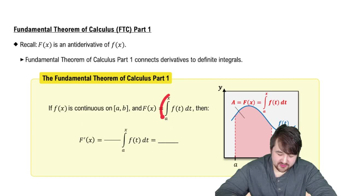
Fundamental Theorem of Calculus

The Fundamental Theorem of Calculus links differentiation and integration, stating that if a function is continuous on an interval, the derivative of its integral is the original function. This theorem allows us to evaluate the derivative of an integral, which is essential for simplifying expressions involving integrals.
Video consigliato:
Percorso guidato
06:11
Fundamental Theorem of Calculus Part 1

Chain Rule

The Chain Rule is a fundamental principle in calculus used to differentiate composite functions. When differentiating an integral with variable limits, the Chain Rule helps in applying the derivative to the upper limit of integration, ensuring that we account for the function's behavior at that point.
Video consigliato:
05:02
Intro to the Chain Rule

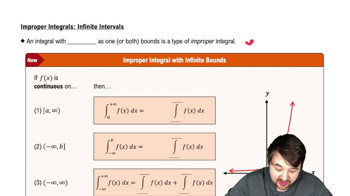
Improper Integrals

Improper integrals involve integrals with infinite limits or integrands that approach infinity within the interval of integration. Understanding how to handle these types of integrals is crucial when evaluating expressions that may include limits approaching zero or infinity, as seen in the second integral of the given expression.
Video consigliato:
Percorso guidato
11:11
Improper Integrals: Infinite Intervals
Pratica correlata
Domanda del libro di testo

Identifying definite integrals as limits of sums Consider the following limits of Riemann sums for a function ƒ on [a,b]. Identify ƒ and express the limit as a definite integral.                                

          n                                                                                                                                                                              

    lim   ∑ (𝓍ₖ*² + 1) ∆𝓍ₖ on [0,2]                                                                                                                                                                            

  ∆ → 0   k=1                                                                                                                                                                                                                      

106
views
Domanda del libro di testo

General results Evaluate the following integrals in which the function ƒ is unspecified. Note that ƒ⁽ᵖ⁾ is the pth derivative of ƒ and ƒᵖ is the pth power of ƒ. Assume ƒ and its derivatives are continuous for all real numbers. 

∫ (5 ƒ³ (𝓍) + 7ƒ² (𝓍) + ƒ (𝓍 )) ƒ'(𝓍) d𝓍

85
views
Domanda del libro di testo

Integrals with sin² 𝓍 and cos² 𝓍 Evaluate the following integrals.                                                                                                             


 ∫ 𝓍 cos²𝓍² d𝓍

81
views
Domanda del libro di testo

Definite integrals Use a change of variables or Table 5.6 to evaluate the following definite integrals.                                                                                                                         


 ∫₋₁¹ (𝓍―1) (𝓍²―2𝓍)⁷ d𝓍

102
views
Domanda del libro di testo

Indefinite integrals Use a change of variables or Table 5.6 to evaluate the following indefinite integrals. Check your work by differentiating.                                                                                  


 ∫ (sin⁵ 𝓍 + 3 sin³ 𝓍― sin 𝓍) cos 𝓍 d𝓍

74
views
Domanda del libro di testo

Use the given substitution to evaluate the following indefinite integrals. Check your answer by differentiating.                                                                                              


 ∫ (6𝓍 + 1) √(3𝓍² + 𝓍) d𝓍 , u = 3𝓍² + 𝓍

52
views