Ch. 5 - Integration
Briggs - Calculus: Early Transcendentals 3rd Edition
Briggs3rd EditionCalculus: Early TranscendentalsISBN: 9780136847243Non è quello che usi tu?Cambia libro di testo
Capitolo 5, Problema 5.3.81

Derivatives of integrals Simplify the following expressions.


d/dz ∫¹⁰ₛᵢₙ ₂ dt /(t⁴ + 1)

Guida verificata passo dopo passo
1
Step 1: Recognize that the problem involves the derivative of an integral. This is a classic application of the Fundamental Theorem of Calculus, which states that if F(x) = ∫[a(x), b(x)] f(t) dt, then dF/dx = f(b(x)) * b'(x) - f(a(x)) * a'(x).
Step 2: Identify the bounds of the integral. The upper bound is 10, which is constant, and the lower bound is sin(z), which is a function of z. This means the derivative will involve the lower bound's derivative.
Step 3: Apply the Fundamental Theorem of Calculus. Since the upper bound is constant, its derivative contributes nothing. For the lower bound, substitute t = sin(z) into the integrand f(t) = 1/(t⁴ + 1), and multiply by the derivative of sin(z), which is cos(z).
Step 4: Write the expression for the derivative. The result is -[1/(sin(z)⁴ + 1)] * cos(z). The negative sign comes from the fact that the lower bound contributes negatively in the Fundamental Theorem of Calculus.
Step 5: Simplify the expression if needed. The derivative is now expressed in terms of z, and no further simplification is required unless specified.

Risposta video verificata per un problema simile:

Questa soluzione video è stata consigliata dai nostri tutor come utile per risolvere questo problema.
Durata del video:
2m

Concetti chiave

Ecco i concetti essenziali che devi comprendere per rispondere correttamente alla domanda.

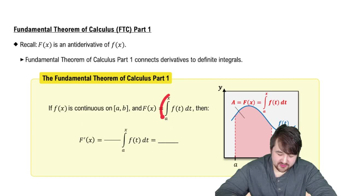
Fundamental Theorem of Calculus

The Fundamental Theorem of Calculus links differentiation and integration, stating that if F is an antiderivative of f on an interval [a, b], then the integral of f from a to b can be computed as F(b) - F(a). This theorem also implies that the derivative of an integral function is the integrand evaluated at the upper limit of integration, which is crucial for simplifying expressions involving derivatives of integrals.
Video consigliato:
Percorso guidato
06:11
Fundamental Theorem of Calculus Part 1

Definite Integral

A definite integral represents the signed area under a curve defined by a function over a specific interval [a, b]. It is denoted as ∫_a^b f(x) dx and provides a numerical value that reflects the accumulation of quantities, such as area or total change, over that interval. Understanding how to evaluate definite integrals is essential for applying the Fundamental Theorem of Calculus.
Video consigliato:
Percorso guidato
05:43
Definition of the Definite Integral

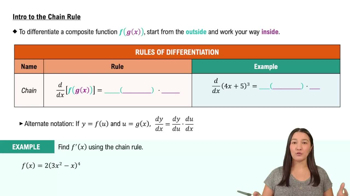
Chain Rule

The Chain Rule is a fundamental principle in calculus used to differentiate composite functions. It states that if a function y = f(g(x)) is composed of two functions, the derivative dy/dx can be found by multiplying the derivative of the outer function f with respect to g by the derivative of the inner function g with respect to x. This rule is particularly useful when dealing with integrals that have variable limits, as seen in the given expression.
Video consigliato:
05:02
Intro to the Chain Rule
Pratica correlata
Domanda del libro di testo

Use the given substitution to evaluate the following indefinite integrals. Check your answer by differentiating.                                                                                              


 ∫ (6𝓍 + 1) √(3𝓍² + 𝓍) d𝓍 , u = 3𝓍² + 𝓍

52
views

Domanda del libro di testo

Use a substitution of the form u = a𝓍 + b to evaluate the following indefinite integrals.

∫(𝓍 + 1)¹² d𝓍

61
views
Domanda del libro di testo

Average height of a wave The surface of a water wave is described by y = 5 (1 + cos 𝓍) , for ― π ≤ 𝓍 ≤ π, where y = 0 corresponds to a trough of the wave (see figure). Find the average height of the wave above the trough on [ ―π , π] .

65
views
Domanda del libro di testo

Areas of regions Find the area of the region bounded by the graph of ƒ and the 𝓍-axis on the given interval.


ƒ(𝓍) = 𝓍³ ― 1 on [―1, 2]

102
views
Domanda del libro di testo

Approximating displacement The velocity of an object is given by the following functions on a specified interval. Approximate the displacement of the object on this interval by subdividing the interval into n subintervals. Use the left endpoint of each subinterval to compute the height of the rectangles.

{Use of Tech} v = 4 √(t +1) (mi/hr) . for 0 ≤ t ≤ 15 ; n = 5     

47
views
Domanda del libro di testo

The composite function ƒ(g(𝓍)) consists of an inner function g and an outer function ƒ. If an integrand includes ƒ(g(𝓍)), which function is often a likely choice for a new variable u?

58
views