Ch. 5 - Integration
Briggs - Calculus: Early Transcendentals 3rd Edition
Briggs3rd EditionCalculus: Early TranscendentalsISBN: 9780136847243Non è quello che usi tu?Cambia libro di testo
Capitolo 5, Problema 5.3.6

Evaluate ∫₀² 3𝓍² d𝓍 and ∫₋₂² 3𝓍² d𝓍. 

Guida verificata passo dopo passo
1
Step 1: Understand the problem. You are tasked with evaluating two definite integrals: ∫₀² 3𝓍² d𝓍 and ∫₋₂² 3𝓍² d𝓍. A definite integral calculates the area under the curve of the function within the specified limits.
Step 2: Recall the formula for the integral of a power function. The integral of 𝓍ⁿ with respect to 𝓍 is (𝓍ⁿ⁺¹)/(n+1) + C, where C is the constant of integration. For definite integrals, the constant of integration is not needed because we evaluate the function at the limits.
Step 3: Apply the formula to the function 3𝓍². The integral of 3𝓍² is (3𝓍³)/3 = 𝓍³. This simplifies the integral to ∫ₐᵇ 𝓍³ d𝓍, where 'a' and 'b' are the limits of integration.
Step 4: Evaluate the first integral ∫₀² 𝓍³ d𝓍. Substitute the upper limit (𝓍 = 2) and lower limit (𝓍 = 0) into the antiderivative 𝓍³. Compute the difference: [𝓍³]₀² = (2³) - (0³).
Step 5: Evaluate the second integral ∫₋₂² 𝓍³ d𝓍. Substitute the upper limit (𝓍 = 2) and lower limit (𝓍 = -2) into the antiderivative 𝓍³. Compute the difference: [𝓍³]₋₂² = (2³) - ((-2)³).

Risposta video verificata per un problema simile:

Questa soluzione video è stata consigliata dai nostri tutor come utile per risolvere questo problema.
Durata del video:
2m

Concetti chiave

Ecco i concetti essenziali che devi comprendere per rispondere correttamente alla domanda.

Definite Integral

A definite integral represents the signed area under a curve defined by a function over a specific interval. It is calculated using the Fundamental Theorem of Calculus, which connects differentiation and integration. The limits of integration indicate the interval over which the area is calculated, and the result is a numerical value that reflects this area.
Video consigliato:
Percorso guidato
05:43
Definition of the Definite Integral

Power Rule for Integration

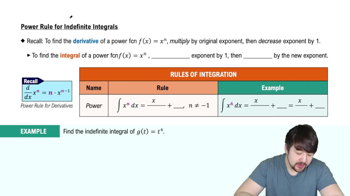
The Power Rule for Integration is a fundamental technique used to find the integral of polynomial functions. It states that the integral of x raised to the power n is (x^(n+1))/(n+1) + C, where n is not equal to -1. This rule simplifies the process of integrating functions like 3x², making it easier to compute definite integrals.
Video consigliato:
Percorso guidato
04:04
Power Rule for Indefinite Integrals

Symmetry in Integrals

Symmetry in integrals refers to the property that can simplify calculations, particularly when dealing with even and odd functions. An even function, f(x), satisfies f(-x) = f(x), and its integral over a symmetric interval around zero can be simplified. Conversely, an odd function satisfies f(-x) = -f(x), and its integral over a symmetric interval is zero, which can be useful in evaluating integrals like ∫₋₂² 3x² dx.
Video consigliato:
Percorso guidato
06:18
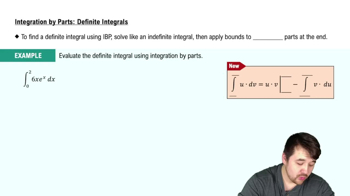
Integration by Parts for Definite Integrals
Pratica correlata
Domanda del libro di testo

Does a right Riemann sum underestimate or overestimate the area of the region under the graph of a function that is positive and decreasing on an interval [a,b]? Explain.

128
views

Domanda del libro di testo

Suppose F is an antiderivative of ƒ and A is an area function of ƒ. What is the relationship between F and A?

77
views
Domanda del libro di testo

Indefinite integrals Use a change of variables or Table 5.6 to evaluate the following indefinite integrals. Check your work by differentiating.                                                                                  


 ∫ 2 / (𝓍√4𝓍² ―1) d𝓍 , 𝓍 > ½ 

61
views
Domanda del libro di testo

Use symmetry to explain why.

∫⁴₋₄ (5𝓍⁴ + 3𝓍³ + 2𝓍² + 𝓍 + 1) d𝓍 = 2 ∫₀⁴ (5𝓍⁴ + 2𝓍² + 𝓍 + 1) d𝓍 .

52
views
Domanda del libro di testo

Variations on the substitution method Evaluate the following integrals.                                                                                                        


 ∫ (𝒵 + 1) √(3𝒵 + 2) d𝒵

68
views
Domanda del libro di testo

Definite integrals Use a change of variables or Table 5.6 to evaluate the following definite integrals.                                                                                                                         


 ∫₂/₍₅√₃₎^²/⁵ d𝓍/ x√(25𝓍²― 1)

38
views