
Ch. 5 - Integration
Briggs - Calculus: Early Transcendentals 3rd Edition
Briggs3rd EditionCalculus: Early TranscendentalsISBN: 9780136847243Non è quello che usi tu?Cambia libro di testo
Capitolo 5, Problema 5.R.62

Evaluating integrals Evaluate the following integrals.                                                                                                                                         
                                                                                                                                                                    
 ∫ y² /(y³ + 27) dy

Guida verificata passo dopo passo
1
Step 1: Recognize that the integral involves a rational function with a cubic polynomial in the denominator. This suggests that partial fraction decomposition or substitution might be useful.
Step 2: Observe that the denominator y³ + 27 can be factored using the sum of cubes formula: y³ + 27 = (y + 3)(y² - 3y + 9).
Step 3: Rewrite the integral as ∫ y² / [(y + 3)(y² - 3y + 9)] dy. At this point, consider substitution to simplify the integral.
Step 4: Let u = y³ + 27, so that du = 3y² dy. This substitution simplifies the integral to (1/3) ∫ du / u.
Step 5: Solve the simplified integral (1/3) ∫ du / u, which is a standard logarithmic integral. The result will involve ln|u| + C, where u = y³ + 27.

Risposta video verificata per un problema simile:

Questa soluzione video è stata consigliata dai nostri tutor come utile per risolvere questo problema.
Durata del video:
2m

Concetti chiave

Ecco i concetti essenziali che devi comprendere per rispondere correttamente alla domanda.

Integration

Integration is a fundamental concept in calculus that involves finding the integral of a function, which represents the area under the curve of that function on a given interval. It can be understood as the reverse process of differentiation. There are various techniques for integration, including substitution, integration by parts, and partial fractions, each suited for different types of integrands.
Video consigliato:
Percorso guidato
06:18
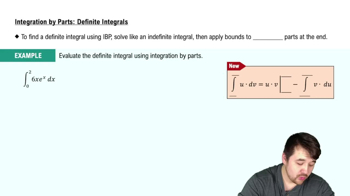
Integration by Parts for Definite Integrals

Rational Functions

A rational function is a function that can be expressed as the ratio of two polynomials. In the context of integration, rational functions often require specific techniques for integration, such as partial fraction decomposition, which breaks down complex fractions into simpler components that are easier to integrate. Understanding the behavior of rational functions is crucial for evaluating their integrals.
Video consigliato:
6:04
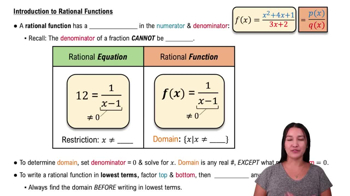
Intro to Rational Functions

Substitution Method

The substitution method is a technique used in integration to simplify the integrand by changing variables. This method involves substituting a part of the integral with a new variable, which can make the integral easier to evaluate. It is particularly useful when dealing with composite functions or when the integrand contains a function and its derivative.
Video consigliato:
07:33
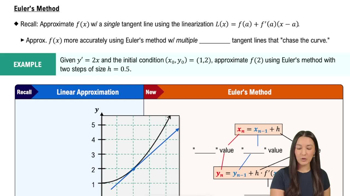
Euler's Method
Pratica correlata
Domanda del libro di testo

Explain why or why not Determine whether the following statements are true and give an explanation or counterexample. Assume ƒ and ƒ' are continuous functions for all real numbers.

(g) ∫ ƒ' (g(𝓍))g' (𝓍) d(𝓍) = ƒ(g(𝓍)) + C .

34
views
Domanda del libro di testo

Evaluating integrals Evaluate the following integrals.                                                                                                                                         


 ∫ sin 𝒵 sin (cos 𝒵) d𝒵

56
views
Domanda del libro di testo

Function defined by an integral Let H (𝓍) = ∫₀ˣ √(4 ― t²) dt, for ― 2 ≤ 𝓍 ≤ 2.

(c) Evaluate H '(2) .

83
views
Domanda del libro di testo

Explain why or why not Determine whether the following statements are true and give an explanation or counterexample. Assume ƒ and ƒ' are continuous functions for all real numbers.

(f) ∫ₐᵇ (2 ƒ(𝓍) ―3g (𝓍)) d𝓍 = 2 ∫ₐᵇ ƒ(𝓍) d𝓍 + 3 ∫₆ᵃ g(𝓍) d𝓍 .

37
views
Domanda del libro di testo

Explain why or why not Determine whether the following statements are true and give an explanation or counterexample. Assume ƒ and ƒ' are continuous functions for all real numbers.

(b) Given an area function A(𝓍) = ∫ₐˣ ƒ(t) dt and an antiderivative F of ƒ, it follows that A'(𝓍) = F(𝓍) .

46
views
Domanda del libro di testo

Evaluating integrals Evaluate the following integrals.                                                                                                                                         


 ∫ (cos 7ω) /(16 + sin² 7ω) dω 

71
views