Ch. 5 - Integration
Briggs - Calculus: Early Transcendentals 3rd Edition
Briggs3rd EditionCalculus: Early TranscendentalsISBN: 9780136847243Non è quello che usi tu?Cambia libro di testo
Capitolo 5, Problema 5.5.95c

Explain why or why not Determine whether the following statements are true and give an explanation or counterexample. Assume ƒ, ƒ', and ƒ'' are continuous functions for all real numbers.                                                                                                                                                           
                                                                                                                                                                    
(c) ∫ sin 2𝓍 d𝓍 = 2 ∫ sin 𝓍 d𝓍 .

Guida verificata passo dopo passo
1
Step 1: Begin by analyzing the given statement: ∫ sin(2𝓍) d𝓍 = 2 ∫ sin(𝓍) d𝓍. The goal is to determine whether this equality holds true or not.
Step 2: Recall the property of definite integrals and substitution. The integral of a function multiplied by a constant inside the argument does not directly equate to multiplying the integral by that constant. Instead, substitution is required to evaluate the integral properly.
Step 3: Use substitution to evaluate ∫ sin(2𝓍) d𝓍. Let u = 2𝓍, which implies du = 2 d𝓍. Rewrite the integral as (1/2) ∫ sin(u) du.
Step 4: Compare the rewritten integral (1/2) ∫ sin(u) du with the original statement. Notice that the factor of 1/2 appears due to the substitution, which contradicts the claim that ∫ sin(2𝓍) d𝓍 = 2 ∫ sin(𝓍) d𝓍.
Step 5: Conclude that the given statement is false. Provide a counterexample or explanation showing that the integral of sin(2𝓍) is not simply twice the integral of sin(𝓍), but rather involves a scaling factor due to substitution.

Risposta video verificata per un problema simile:

Questa soluzione video è stata consigliata dai nostri tutor come utile per risolvere questo problema.
Durata del video:
2m

Concetti chiave

Ecco i concetti essenziali che devi comprendere per rispondere correttamente alla domanda.

Integration

Integration is a fundamental concept in calculus that involves finding the integral of a function, which represents the area under the curve of that function. It is the reverse process of differentiation and can be used to calculate quantities such as total distance, area, and volume. Understanding the properties of integrals, including linearity and substitution, is crucial for solving integration problems.
Video consigliato:
Percorso guidato
06:18
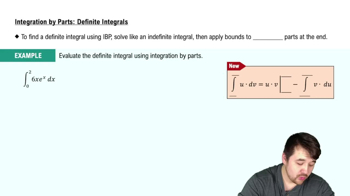
Integration by Parts for Definite Integrals

Trigonometric Functions

Trigonometric functions, such as sine and cosine, are periodic functions that relate angles to ratios of sides in right triangles. In calculus, these functions are essential for modeling oscillatory behavior and are frequently encountered in integration and differentiation. Recognizing the properties and identities of trigonometric functions is vital for simplifying expressions and solving integrals involving these functions.
Video consigliato:
Percorso guidato
6:04
Introduction to Trigonometric Functions

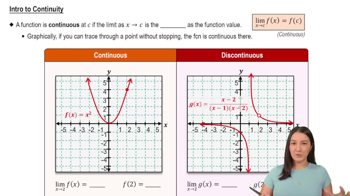
Continuous Functions

A continuous function is one that does not have any breaks, jumps, or holes in its graph. For a function to be continuous at a point, the limit of the function as it approaches that point must equal the function's value at that point. In the context of the question, the continuity of the functions ƒ, ƒ', and ƒ'' ensures that the properties of integration and differentiation can be applied without concern for discontinuities, which is essential for validating the given statement.
Video consigliato:
05:34
Intro to Continuity
Pratica correlata
Domanda del libro di testo

Working with area functions Consider the function ƒ and its graph.

(c) Sketch a graph of A, for 0 ≤ 𝓍 ≤ 10 , without a scale on the y-axis.


64
views

Domanda del libro di testo

Sigma notation Express the following sums using sigma notation. (Answers are not unique.)

(c) 1² + 2² + 3² + 4²

80
views
Domanda del libro di testo

Zero net area Consider the function ƒ(𝓍) = 𝓍² ― 4𝓍 .                                                                                                                                       

                                                                                                                                                                                     c) In general, for the function ƒ(𝓍) = 𝓍² ― a𝓍, where a > 0, for what value of b > 0 (as a function of a) is ∫₀ᵇ ƒ(𝓍) d𝓍 = 0 ? 

49
views
Domanda del libro di testo

Working with area functions Consider the function ƒ and the points a, b, and c.

(c) Evaluate A(b) and A(c). Interpret the results using the graphs of part (b) .

ƒ(𝓍) = ― 12𝓍 (𝓍―1) (𝓍― 2) ; a = 0 , b = 1 , c = 2

62
views
Domanda del libro di testo

Approximating areas Estimate the area of the region bounded by the graph of ƒ(𝓍) = x² + 2 and the x-axis on [0, 2] in the following ways.

(c) Divide [0, 2] into n = 4 subintervals and approximate the area of the region using a right Riemann sum. Illustrate the solution geometrically.

74
views
Domanda del libro di testo

{Use of Tech} Approximating definite integrals Complete the following steps for the given integral and the given value of n. 

(c) Calculate the left and right Riemann sums for the given value of n.


∫₀^π/2 cos 𝓍 d𝓍 ; n = 4

94
views