Ch. 5 - Integration
Briggs - Calculus: Early Transcendentals 3rd Edition
Briggs3rd EditionCalculus: Early TranscendentalsISBN: 9780136847243Non è quello che usi tu?Cambia libro di testo
Capitolo 5, Problema 5.5.22

Indefinite integrals Use a change of variables or Table 5.6 to evaluate the following indefinite integrals. Check your work by differentiating.                                                                                  
                                                                                                                                                                    
 ∫ [ 1/(10𝓍―3) d𝓍

Guida verificata passo dopo passo
1
Step 1: Recognize that the integral ∫ [1/(10𝓍 - 3)] d𝓍 can be solved using a substitution method. Let u = 10𝓍 - 3, which simplifies the denominator.
Step 2: Compute the derivative of u with respect to 𝓍. Since u = 10𝓍 - 3, du/d𝓍 = 10. Rearrange to express d𝓍 in terms of du: d𝓍 = du/10.
Step 3: Substitute u and d𝓍 into the integral. The integral becomes ∫ [1/u] * (du/10), which simplifies to (1/10) ∫ [1/u] du.
Step 4: Recall the standard integral formula ∫ [1/u] du = ln|u| + C, where C is the constant of integration. Apply this formula to the integral.
Step 5: Replace u with the original variable to return to the terms of 𝓍. Since u = 10𝓍 - 3, the solution becomes (1/10) ln|10𝓍 - 3| + C.

Risposta video verificata per un problema simile:

Questa soluzione video è stata consigliata dai nostri tutor come utile per risolvere questo problema.
Durata del video:
1m

Concetti chiave

Ecco i concetti essenziali che devi comprendere per rispondere correttamente alla domanda.

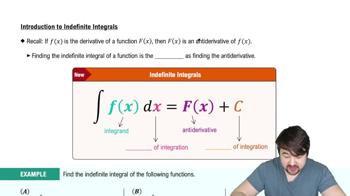
Indefinite Integrals

Indefinite integrals represent a family of functions whose derivative is the integrand. They are expressed without limits and include a constant of integration, typically denoted as 'C'. The process of finding an indefinite integral is often referred to as antidifferentiation, and it is fundamental in calculus for solving problems related to area under curves and accumulation functions.
Video consigliato:
Percorso guidato
05:04
Introduction to Indefinite Integrals

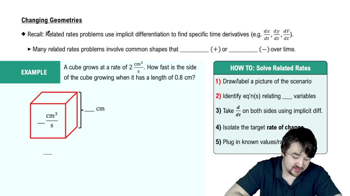
Change of Variables

Change of variables, or substitution, is a technique used in integration to simplify the integrand. By substituting a new variable for a function of the original variable, the integral can often be transformed into a more manageable form. This method is particularly useful when dealing with complex functions or when the integrand can be expressed in a simpler way through a different variable.
Video consigliato:
Percorso guidato
06:35
Changing Geometries

Differentiation Check

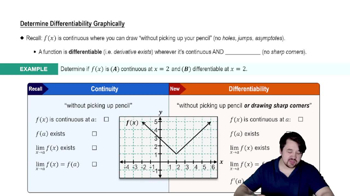
Checking work by differentiation involves taking the derivative of the result obtained from an indefinite integral to verify its correctness. If the derivative of the antiderivative matches the original integrand, the solution is confirmed to be correct. This step is crucial in calculus as it ensures that the integration process has been performed accurately and helps identify any potential errors in the calculations.
Video consigliato:
05:02
Determining Differentiability Graphically
Pratica correlata
Domanda del libro di testo

Areas of regions Find the area of the following regions.                                                                                                                   

                                                                                                                                                                 The region bounded by the graph of ƒ(𝓍) = x /√(𝓍² ―9) and the 𝓍-axis between and 𝓍 = 4 and 𝓍= 5

28
views

Domanda del libro di testo

Indefinite integrals Use a change of variables or Table 5.6 to evaluate the following indefinite integrals. Check your work by differentiating.                                                                                  


 ∫ 2𝓍(𝓍² ― 1)⁹⁹ d𝓍

86
views
Domanda del libro di testo

Multiple substitutions If necessary, use two or more substitutions to find the following integrals.                                                                                    


  ∫₀^π/² (cos θ sin θ) / √(cos² θ + 16) dθ (Hint: Begin with u = cos θ .)

44
views
Domanda del libro di testo

Suppose an object moves along a line at 15 m/s, for 0 ≤ t < 2 and at 25 m/s, for 2 ≤ t ≤ 5, where t is measured in seconds. Sketch the graph of the velocity function and find the displacement of the object for 0 ≤ t ≤ 5.

47
views
Domanda del libro di testo

Explain why ∫ₐᵇ ƒ ′(𝓍) d𝓍 = ƒ(b) ― ƒ(a)

85
views
Domanda del libro di testo

Definite integrals from graphs The figure shows the areas of regions bounded by the graph of ƒ and the 𝓍-axis. Evaluate the following integrals.


∫ₐᶜ ƒ(𝓍) d𝓍

102
views