Ch. 5 - Integration
Briggs - Calculus: Early Transcendentals 3rd Edition
Briggs3rd EditionCalculus: Early TranscendentalsISBN: 9780136847243Non è quello che usi tu?Cambia libro di testo
Capitolo 5, Problema 5.5.1

On which derivative rule is the Substitution Rule based?

Guida verificata passo dopo passo
1
The Substitution Rule in calculus is based on the Chain Rule for derivatives. Let's explore this connection step by step.
Step 1: Recall the Chain Rule. The Chain Rule states that if a function y = f(g(x)) is composed of two functions, its derivative is given by: ddxf(g(x))=dfdg⋅dgdx
Step 2: The Substitution Rule is used in integration to simplify the process of finding antiderivatives. It involves substituting a part of the integrand with a new variable, typically u, where u = g(x).
Step 3: When applying the Substitution Rule, we rewrite the integral in terms of u and du. This process mirrors the Chain Rule because we are essentially reversing the differentiation process.
Step 4: The connection lies in the fact that the derivative of the inner function g(x) (from the Chain Rule) corresponds to the differential du = g'(x) dx in the Substitution Rule.

Risposta video verificata per un problema simile:

Questa soluzione video è stata consigliata dai nostri tutor come utile per risolvere questo problema.
Durata del video:
1m

Concetti chiave

Ecco i concetti essenziali che devi comprendere per rispondere correttamente alla domanda.

Chain Rule

The Chain Rule is a fundamental derivative rule in calculus that allows us to differentiate composite functions. It states that if a function y is composed of another function u, then the derivative of y with respect to x can be found by multiplying the derivative of y with respect to u by the derivative of u with respect to x. This rule is essential for the Substitution Rule, as it enables the transformation of variables in integrals and derivatives.
Video consigliato:
05:02
Intro to the Chain Rule

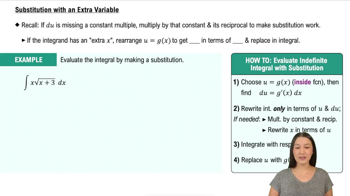
Substitution Rule

The Substitution Rule is a technique used in calculus to simplify the process of finding integrals. It involves substituting a part of the integrand with a new variable, which transforms the integral into a more manageable form. This rule is directly related to the Chain Rule, as it relies on the ability to differentiate composite functions, allowing for easier integration of complex expressions.
Video consigliato:
04:27
Substitution With an Extra Variable

Composite Functions

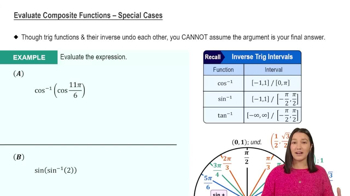
Composite functions are formed when one function is applied to the result of another function. In calculus, understanding composite functions is crucial for applying the Chain Rule and the Substitution Rule effectively. Recognizing how to break down complex functions into simpler components allows for easier differentiation and integration, which is the essence of the Substitution Rule.
Video consigliato:
3:48
Evaluate Composite Functions - Special Cases
Pratica correlata
Domanda del libro di testo

Indefinite integrals Use a change of variables or Table 5.6 to evaluate the following indefinite integrals. Check your work by differentiating.                                                                                  


 ∫ 𝓍 csc 𝓍² cot 𝓍² d𝓍

71
views

Domanda del libro di testo

Area by geometry Use geometry to evaluate the following integrals.


∫⁴₋₆ √(24 ― 2𝓍 ― 𝓍²) d𝓍

82
views
Domanda del libro di testo

Integrals with sin² 𝓍 and cos² 𝓍 Evaluate the following integrals.                                                                                                             


 ∫₋π^π cos² 𝓍 d𝓍

56
views
Domanda del libro di testo

Symmetry in integrals Use symmetry to evaluate the following integrals.

∫₋π/₄^π/⁴ sec² x dx

95
views
Domanda del libro di testo

Indefinite integrals Use a change of variables or Table 5.6 to evaluate the following indefinite integrals. Check your work by differentiating.                                                                                  


 ∫ d𝓍 / (√1 ― 9𝓍²)

92
views
Domanda del libro di testo

{Use of Tech} Areas of regions Find the area of the region 𝑅 bounded by the graph of ƒ and the 𝓍-axis on the given interval. Graph ƒ and show the region 𝑅.                                              


 ƒ(𝓍) = 𝓍² (𝓍 ― 2) on [ ―1 , 3]

29
views