Ch. 5 - Integration
Briggs - Calculus: Early Transcendentals 3rd Edition
Briggs3rd EditionCalculus: Early TranscendentalsISBN: 9780136847243Non è quello che usi tu?Cambia libro di testo
Capitolo 5, Problema 5.2.31c

{Use of Tech} Approximating definite integrals Complete the following steps for the given integral and the given value of n. 
(c) Calculate the left and right Riemann sums for the given value of n.


∫₃⁶ (1―2𝓍) d𝓍 ; n = 6

Guida verificata passo dopo passo
1
Step 1: Understand the problem. You are tasked with approximating the definite integral ∫₃⁶ (1 - 2𝓍) d𝓍 using left and right Riemann sums with n = 6. This means dividing the interval [3, 6] into 6 subintervals and calculating the sum of areas of rectangles using the left and right endpoints of each subinterval.
Step 2: Determine the width of each subinterval, Δ𝓍. The width is calculated as Δ𝓍 = (b - a) / n, where [a, b] is the interval of integration. Here, a = 3, b = 6, and n = 6. Substitute these values into the formula to find Δ𝓍.
Step 3: For the left Riemann sum, identify the left endpoints of each subinterval. These endpoints are x₀, x₁, ..., x₅, where x₀ = a and x₅ = b - Δ𝓍. Evaluate the function f(𝓍) = 1 - 2𝓍 at each left endpoint and multiply each value by Δ𝓍. Sum these products to approximate the integral using the left Riemann sum.
Step 4: For the right Riemann sum, identify the right endpoints of each subinterval. These endpoints are x₁, x₂, ..., x₆, where x₁ = a + Δ𝓍 and x₆ = b. Evaluate the function f(𝓍) = 1 - 2𝓍 at each right endpoint and multiply each value by Δ𝓍. Sum these products to approximate the integral using the right Riemann sum.
Step 5: Compare the left and right Riemann sums. These approximations provide an estimate of the definite integral ∫₃⁶ (1 - 2𝓍) d𝓍. The true value of the integral lies between these two sums, and the accuracy improves as n increases.

Risposta video verificata per un problema simile:

Questa soluzione video è stata consigliata dai nostri tutor come utile per risolvere questo problema.
Durata del video:
5m

Concetti chiave

Ecco i concetti essenziali che devi comprendere per rispondere correttamente alla domanda.

Definite Integral

A definite integral represents the signed area under a curve defined by a function over a specific interval. It is denoted as ∫_a^b f(x) dx, where 'a' and 'b' are the limits of integration. The value of a definite integral can be interpreted as the accumulation of quantities, such as area, over the interval from 'a' to 'b'.
Video consigliato:
Percorso guidato
05:43
Definition of the Definite Integral

Riemann Sum

A Riemann sum is a method for approximating the value of a definite integral by dividing the area under a curve into rectangles. The sum is calculated by taking the function's value at specific points (left endpoints, right endpoints, or midpoints) and multiplying by the width of the subintervals. As the number of rectangles increases, the Riemann sum approaches the exact value of the definite integral.
Video consigliato:
Percorso guidato
06:11
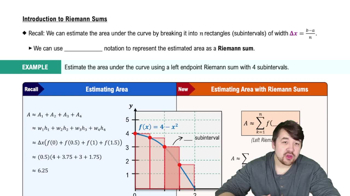
Introduction to Riemann Sums

Left and Right Riemann Sums

Left and right Riemann sums are specific types of Riemann sums that use the leftmost and rightmost points of each subinterval, respectively, to determine the height of the rectangles. For 'n' subintervals, the left Riemann sum uses the function values at the left endpoints, while the right Riemann sum uses the values at the right endpoints. These sums provide different approximations of the definite integral, which can be compared for accuracy.
Video consigliato:
Percorso guidato
07:39
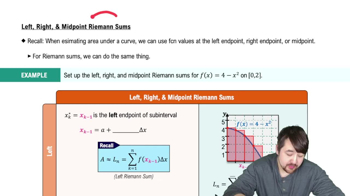
Left, Right, & Midpoint Riemann Sums
Pratica correlata
Domanda del libro di testo

Properties of integrals Suppose ∫₀³ƒ(𝓍) d𝓍 = 2 , ∫₃⁶ƒ(𝓍) d𝓍 = ―5 , and ∫₃⁶g(𝓍) d𝓍 = 1. Evaluate the following integrals.

(c) ∫₃⁶ (3ƒ(𝓍) ― g(𝓍)) d𝓍

42
views

Domanda del libro di testo

{Use of Tech} Approximating definite integrals Complete the following steps for the given integral and the given value of n. 

(c) Calculate the left and right Riemann sums for the given value of n.


∫₀² (𝓍²―2) d𝓍 ; n = 4

80
views
Domanda del libro di testo

Use Table 5.6 to evaluate the following definite integrals.                                                                                                                    

 (c) ∫₃√₂^⁶ d𝓍/(𝓍² ―9)

87
views
Domanda del libro di testo

Displacement from a velocity graph Consider the velocity function for an object moving along a line (see figure).

(c) Use geometry to find the displacement of the object between t = 2 and t = 5.

100
views
Domanda del libro di testo

Mass from density A thin 10-cm rod is made of an alloy whose density varies along its length according to the function shown in the figure. Assume density is measured in units of g/cm. In Chapter 6, we show that the mass of the rod is the area under the density curve.

(c) Find the mass of the entire rod (0 ≤ x ≤ 10) .

53
views
Domanda del libro di testo

Approximating areas Estimate the area of the region bounded by the graph of ƒ(𝓍) = x² + 2 and the x-axis on [0, 2] in the following ways.

(c) Divide [0, 2] into n = 4 subintervals and approximate the area of the region using a right Riemann sum. Illustrate the solution geometrically.

74
views