

Ch. 5 - Integration
Briggs - Calculus: Early Transcendentals 3rd Edition
Briggs3rd EditionCalculus: Early TranscendentalsISBN: 9780136847243Non è quello che usi tu?Cambia libro di testo
Capitolo 5, Problema 5.2.33d

{Use of Tech} Approximating definite integrals Complete the following steps for the given integral and the given value of n. 
(d) Determine which Riemann sum (left or right) underestimates the value of the definite integral and which overestimates the value of the definite integral.


∫₁⁷ 1/𝓍 d𝓍 ; n = 6

Guida verificata passo dopo passo
1
Step 1: Understand the problem. The integral ∫₁⁷ (1/𝓍) d𝓍 represents the area under the curve of the function f(𝓍) = 1/𝓍 from x = 1 to x = 7. We are tasked with determining which Riemann sum (left or right) underestimates or overestimates the value of this definite integral, given n = 6 subintervals.
Step 2: Divide the interval [1, 7] into n = 6 subintervals. The width of each subinterval, Δ𝓍, is calculated as Δ𝓍 = (7 - 1)/6 = 6/6 = 1. This means the subintervals are [1, 2], [2, 3], [3, 4], [4, 5], [5, 6], and [6, 7].
Step 3: Recall the definitions of the left and right Riemann sums. The left Riemann sum uses the function values at the left endpoints of each subinterval, while the right Riemann sum uses the function values at the right endpoints of each subinterval. For f(𝓍) = 1/𝓍, the left endpoints are {1, 2, 3, 4, 5, 6}, and the right endpoints are {2, 3, 4, 5, 6, 7}.
Step 4: Analyze the behavior of the function f(𝓍) = 1/𝓍. Since f(𝓍) is a decreasing function on the interval [1, 7], the left Riemann sum will underestimate the area (because it uses smaller function values at the left endpoints), and the right Riemann sum will overestimate the area (because it uses larger function values at the right endpoints).
Step 5: Conclude that for the given integral ∫₁⁷ (1/𝓍) d𝓍 and n = 6, the left Riemann sum underestimates the value of the definite integral, while the right Riemann sum overestimates the value of the definite integral.

Risposta video verificata per un problema simile:

Questa soluzione video è stata consigliata dai nostri tutor come utile per risolvere questo problema.
Durata del video:
2m

Concetti chiave

Ecco i concetti essenziali che devi comprendere per rispondere correttamente alla domanda.

Riemann Sums

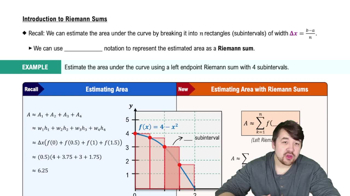
Riemann sums are a method for approximating the value of a definite integral by dividing the area under a curve into rectangles. The sum of the areas of these rectangles provides an estimate of the integral's value. Depending on whether the left or right endpoints of the subintervals are used, the Riemann sum can either overestimate or underestimate the actual area, which is crucial for understanding the behavior of the integral.
Video consigliato:
Percorso guidato
06:11
Introduction to Riemann Sums

Definite Integrals

A definite integral represents the net area under a curve between two specified limits, providing a precise value for the accumulation of quantities. It is denoted as ∫ₐᵇ f(x) dx, where 'a' and 'b' are the limits of integration. Understanding how to evaluate definite integrals is essential for applying Riemann sums effectively, as it allows for comparison between the approximated and actual values.
Video consigliato:
Percorso guidato
05:43
Definition of the Definite Integral

Underestimation and Overestimation

In the context of Riemann sums, underestimation occurs when the sum of the areas of rectangles is less than the actual area under the curve, while overestimation occurs when it is greater. For a decreasing function, the left Riemann sum underestimates and the right Riemann sum overestimates the integral. Conversely, for an increasing function, the left sum overestimates and the right sum underestimates, making it important to analyze the function's behavior to determine which sum to use.
Video consigliato:
Percorso guidato
10:22
Left, Right, & Midpoint Riemann Sums Example 1