Ch. 5 - Integration
Briggs - Calculus: Early Transcendentals 3rd Edition
Briggs3rd EditionCalculus: Early TranscendentalsISBN: 9780136847243Non è quello che usi tu?Cambia libro di testo
Capitolo 5, Problema 5.5.5

When using a change of variables u = g(𝓍) to evaluate the definite integral ∫ₐᵇ ƒ(g(𝓍)) g' (𝓍) d(𝓍), how are the limits of integration transformed?

Guida verificata passo dopo passo
1
Recognize that when performing a substitution in a definite integral, the variable of integration changes from \( x \) to \( u = g(x) \).
The original integral is \( \int_a^b f(g(x)) g'(x) \, dx \). After substitution, \( dx \) is replaced by \( \frac{du}{g'(x)} \), but since \( du = g'(x) dx \), the integral becomes \( \int_{u(a)}^{u(b)} f(u) \, du \).
To find the new limits of integration, evaluate the substitution function \( g(x) \) at the original limits: the lower limit \( a \) transforms to \( u(a) = g(a) \), and the upper limit \( b \) transforms to \( u(b) = g(b) \).
Thus, the definite integral with respect to \( x \) from \( a \) to \( b \) is equivalent to the integral with respect to \( u \) from \( g(a) \) to \( g(b) \).
This change of limits ensures the integral remains consistent under the substitution and allows you to evaluate the integral in terms of \( u \).

Risposta video verificata per un problema simile:

Questa soluzione video è stata consigliata dai nostri tutor come utile per risolvere questo problema.
Durata del video:
1m

Concetti chiave

Ecco i concetti essenziali che devi comprendere per rispondere correttamente alla domanda.

Change of Variables (Substitution) in Integration

This technique simplifies integrals by substituting a new variable u = g(x), transforming the integral into terms of u. It helps to rewrite complex integrals into more manageable forms by changing the variable of integration.
Video consigliato:
04:27
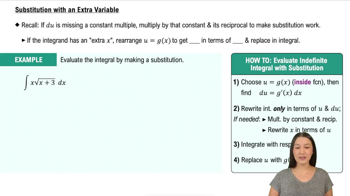
Substitution With an Extra Variable

Derivative of the Substitution Function

When substituting u = g(x), the differential dx is replaced by du = g'(x) dx. This derivative g'(x) adjusts the integrand to maintain equivalence between the original and transformed integrals.
Video consigliato:
04:27
Substitution With an Extra Variable

Transformation of Limits of Integration

In definite integrals, the original limits a and b in terms of x must be converted to new limits in terms of u by evaluating u = g(a) and u = g(b). This ensures the integral's bounds correspond correctly to the substituted variable.
Video consigliato:
Percorso guidato
5:25
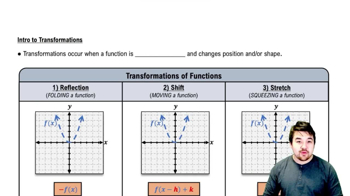
Intro to Transformations
Pratica correlata
Domanda del libro di testo

Does a right Riemann sum underestimate or overestimate the area of the region under the graph of a function that is positive and decreasing on an interval [a,b]? Explain.

128
views

Domanda del libro di testo

{Use of Tech} Sigma notation for Riemann sums Use sigma notation to write the following Riemann sums. Then evaluate each Riemann sum using Theorem 5.1 or a calculator.

The midpoint Riemann sum for f(x) = x³ on [3,11] with n = 32.

83
views
Domanda del libro di testo

Variations on the substitution method Evaluate the following integrals.                                                                                                        


 ∫ 𝓍/(∛𝓍 + 4) d𝓍

54
views
Domanda del libro di testo

Evaluate ∫₃⁸ ƒ ′(t) dt , where ƒ ′ is continuous on [3, 8], ƒ(3) = 4, and ƒ(8) = 20 .

37
views
Domanda del libro di testo

Definite integrals Evaluate the following integrals using the Fundamental Theorem of Calculus


∫₁⁹ 2/(√𝓍) d𝓍

106
views
Domanda del libro di testo

Definite integrals Use a change of variables or Table 5.6 to evaluate the following definite integrals.                                                                                                                         


 ∫₁/₃^¹/√³ 4/(9𝓍² + 1) d𝓍

102
views