
Ch. 6 - Applications of Integration
Briggs - Calculus: Early Transcendentals 3rd Edition
Briggs3rd EditionCalculus: Early TranscendentalsISBN: 9780136847243Non è quello che usi tu?Cambia libro di testo
Capitolo 6, Problema 6.1.16a

13–16. Displacement from velocity Consider an object moving along a line with the given velocity v. Assume time t is measured in seconds and velocities have units of m/s.


a. Determine when the motion is in the positive direction and when it is in the negative direction. 


v(t) = 50e^−2t on [0, 4]

Guida verificata passo dopo passo
1
Identify the velocity function given: \(v(t) = 50e^{-2t}\), where \(t\) is in the interval \([0, 4]\) seconds.
Recall that the direction of motion depends on the sign of the velocity: if \(v(t) > 0\), the object moves in the positive direction; if \(v(t) < 0\), it moves in the negative direction.
Analyze the expression \(50e^{-2t}\). Since \(50\) is positive and the exponential function \(e^{-2t}\) is always positive for all real \(t\), the velocity \(v(t)\) is always positive on the interval \([0, 4]\).
Conclude that the object moves in the positive direction for all \(t\) in \([0, 4]\) because \(v(t) > 0\) throughout this interval.
Note that since \(v(t)\) never becomes negative or zero (except possibly at infinity), the object does not move in the negative direction during the given time interval.

Risposta video verificata per un problema simile:

Questa soluzione video è stata consigliata dai nostri tutor come utile per risolvere questo problema.
Durata del video:
2m

Concetti chiave

Ecco i concetti essenziali che devi comprendere per rispondere correttamente alla domanda.

Velocity and Direction of Motion

Velocity indicates both the speed and direction of an object's motion. A positive velocity means the object moves in the positive direction along the line, while a negative velocity means motion in the opposite direction. Understanding the sign of velocity helps determine when the object changes direction.
Video consigliato:
Percorso guidato
06:29
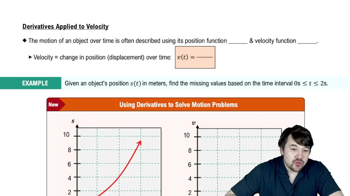
Derivatives Applied To Velocity

Exponential Decay Function

The velocity function v(t) = 50e^(-2t) is an exponential decay, meaning the velocity decreases over time but remains positive since e^(-2t) > 0 for all t. This implies the object slows down but continues moving in the positive direction on the interval [0,4].
Video consigliato:
09:29
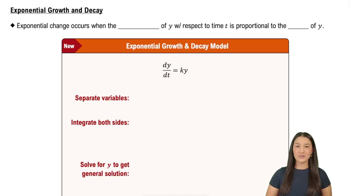
Exponential Growth & Decay

Time Interval Analysis

Analyzing the velocity over a specific time interval [0,4] involves evaluating the function at various points to understand motion behavior. Since velocity remains positive throughout this interval, the object moves positively without reversing direction during this time.
Video consigliato:
08:44
Interval of Convergence
Pratica correlata
Domanda del libro di testo

Volume of a sphere Let R be the region bounded by the upper half of the circle x²+y² = r² and the x-axis. A sphere of radius r is obtained by revolving R about the x-axis.


a. Use the shell method to verify that the volume of a sphere of radius r is 4/3 πr³.

70
views
Domanda del libro di testo

21–30. {Use of Tech} Arc length by calculator


a. Write and simplify the integral that gives the arc length of the following curves on the given interval. 

y = 1/x, for 1 ≤ x ≤ 10

59
views
Domanda del libro di testo

Functions from arc length What differentiable functions have an arc length on the interval [a, b] given by the following integrals? Note that the answers are not unique. Give a family of functions that satisfy the conditions.

a. ∫a^b √1+16x⁴ dx

60
views
Domanda del libro di testo

21–30. {Use of Tech} Arc length by calculator


a. Write and simplify the integral that gives the arc length of the following curves on the given interval. 

y = x³/3, for −1≤x≤1

60
views
Domanda del libro di testo

Let R be the region in the first quadrant bounded above by the curve y=2−x² and bounded below by the line y=x. Suppose the shell method is used to determine the volume of the solid generated by revolving R about the y-axis.

a. What is the radius of a cylindrical shell at a point x in [0, 2]?

70
views
Domanda del libro di testo

A right circular cylinder with height R and radius R has a volume of VC=πR^3 (height = radius).


a. Find the volume of the cone that is inscribed in the cylinder with the same base as the cylinder and height R. Express the volume in terms of VC.

87
views