

Ch. 6 - Applications of Integration
Briggs - Calculus: Early Transcendentals 3rd Edition
Briggs3rd EditionCalculus: Early TranscendentalsISBN: 9780136847243Non è quello che usi tu?Cambia libro di testo
Capitolo 6, Problema 6.1.14c

13–16. Displacement from velocity Consider an object moving along a line with the given velocity v. Assume time t is measured in seconds and velocities have units of m/s.


c. Find the distance traveled over the given interval.


v(t) = 4t³ - 24t²+20t on [0, 5]

Guida verificata passo dopo passo
1
Step 1: Understand the problem. The goal is to find the total distance traveled by the object over the interval [0, 5]. Distance is calculated by integrating the absolute value of the velocity function v(t) over the given interval.
Step 2: Identify the velocity function v(t) = 4t³ - 24t² + 20t and the interval [0, 5]. To compute the distance, we need to account for any changes in direction (where v(t) = 0) because the absolute value of velocity is required.
Step 3: Solve for the critical points where v(t) = 0. Set 4t³ - 24t² + 20t = 0 and factorize the equation: t(4t² - 24t + 20) = 0. Solve for t to find the points where the velocity changes sign within the interval [0, 5].
Step 4: Determine the sign of v(t) in each subinterval created by the critical points. This involves testing the sign of v(t) in intervals such as [0, t₁], [t₁, t₂], ..., [tₙ, 5], where t₁, t₂, ..., tₙ are the critical points. Use these signs to apply the absolute value of v(t) in the integration.
Step 5: Compute the total distance traveled by integrating |v(t)| over each subinterval. For each subinterval, integrate the absolute value of v(t) and sum the results to find the total distance. Use the formula: ∫|v(t)| dt from t=a to t=b for each subinterval.

Risposta video verificata per un problema simile:

Questa soluzione video è stata consigliata dai nostri tutor come utile per risolvere questo problema.
Durata del video:
4m

Concetti chiave

Ecco i concetti essenziali che devi comprendere per rispondere correttamente alla domanda.

Velocity Function

The velocity function v(t) describes the rate of change of an object's position with respect to time. In this case, v(t) = 4t³ - 24t² + 20t is a polynomial function that indicates how the object's speed varies over time. Understanding this function is crucial for determining how far the object travels during a specific time interval.
Video consigliato:
Percorso guidato
10:17
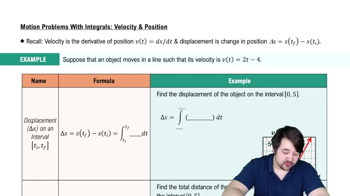
Using The Velocity Function

Definite Integral

To find the distance traveled over a time interval, we use the definite integral of the velocity function. The integral calculates the net area under the velocity curve from the start to the end of the interval, which corresponds to the total displacement. In this problem, we will evaluate the integral of v(t) from t = 0 to t = 5.
Video consigliato:
Percorso guidato
05:43
Definition of the Definite Integral

Distance vs. Displacement

While displacement refers to the change in position from the start to the end of the interval, distance accounts for the total path traveled, regardless of direction. If the velocity function changes sign within the interval, it indicates that the object may reverse direction, which affects the total distance calculation. Thus, it is important to analyze the velocity function for any intervals where it may be negative.
Video consigliato:
Percorso guidato
08:56
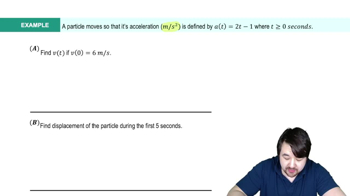
Using The Acceleration Function Example 1
Pratica correlata
Domanda del libro di testo

A nonlinear spring Hooke’s law is applicable to idealized (linear) springs that are not stretched or compressed too far from their equilibrium positions. Consider a nonlinear spring whose restoring force is given by F(x) = 16x−0.1x³, for |x|≤7. 

c. How much work is done in compressing the spring from its equilibrium position (x=0) to x=−2?

89
views
Domanda del libro di testo

Probe speed A data collection probe is dropped from a stationary balloon, and it falls with a velocity (in m/s) given by v(t) = 9.8t, neglecting air resistance. After 10 s, a chute deploys and the probe immediately slows to a constant speed of 10 m/s, which it maintains until it enters the ocean.


c. If the probe was released from an altitude of 3 km, when does it enter the ocean?

46
views
Domanda del libro di testo

Oscillating growth rates Some species have growth rates that oscillate with an (approximately) constant period P. Consider the growth rate function N'(t) = r+A sin 2πt/P, where A and r are constants with units of individuals/yr, and t is measured in years. A species becomes extinct if its population ever reaches 0 after t=0.


c. Suppose P=10, A=50, and r=5. If the initial population is N(0)=10, does the population ever become extinct? Explain.

42
views
Domanda del libro di testo

Region R is revolved about the line y=1 to form a solid of revolution.


c. Write an integral for the volume of the solid.

73
views
Domanda del libro di testo

Explain why or why not Determine whether the following statements are true and give an explanation or counterexample.

c. The work required to lift a 10-kg object vertically 10 m is the same as the work required to lift a 20-kg object vertically 5 m.

49
views
Domanda del libro di testo

Determine whether the following statements are true and give an explanation or counterexample.


c. ∫₀¹(x−x^2) dx=∫₀¹(√y−y) dy

54
views