Ch. 6 - Applications of Integration
Briggs - Calculus: Early Transcendentals 3rd Edition
Briggs3rd EditionCalculus: Early TranscendentalsISBN: 9780136847243Non è quello che usi tu?Cambia libro di testo
Capitolo 6, Problema 6.5.4

3–6. Setting up arc length integrals Write and simplify, but do not evaluate, an integral with respect to x that gives the length of the following curves on the given interval.
y = 2 cos 3x on [−π,π]

Guida verificata passo dopo passo
1
Step 1: Recall the formula for the arc length of a curve y = f(x) on the interval [a, b]. The arc length is given by: ∫ab1+dydx2dx.
Step 2: Compute the derivative of y = 2 cos(3x) with respect to x. Using the chain rule, the derivative is: dydx=-6sin(3x).
Step 3: Substitute the derivative into the arc length formula. The integrand becomes: 1+(-6sin(3x))2.
Step 4: Simplify the square of the derivative. Squaring -6sin(3x) gives: -6sin(3x)2=36sin(3x)2.
Step 5: Write the integral for the arc length. The integral becomes: ∫-ππ1+36sin(3x)2dx.

Risposta video verificata per un problema simile:

Questa soluzione video è stata consigliata dai nostri tutor come utile per risolvere questo problema.
Durata del video:
3m

Concetti chiave

Ecco i concetti essenziali che devi comprendere per rispondere correttamente alla domanda.

Arc Length Formula

The arc length of a curve defined by a function y = f(x) from x = a to x = b is given by the integral L = ∫[a to b] √(1 + (dy/dx)²) dx. This formula derives from the Pythagorean theorem, where the infinitesimal segments of the curve are approximated as straight lines.
Video consigliato:
Percorso guidato
06:29
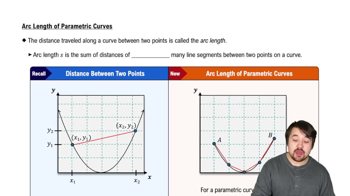
Arc Length of Parametric Curves

Derivative of a Function

The derivative of a function, denoted as dy/dx, represents the rate of change of the function with respect to x. For the curve y = 2 cos(3x), finding the derivative is essential to apply the arc length formula, as it will be squared and added to 1 under the square root in the integral.
Video consigliato:
06:30
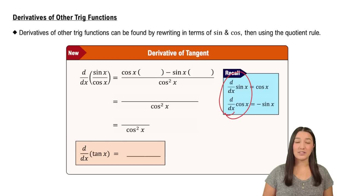
Derivatives of Other Trig Functions

Definite Integral

A definite integral calculates the accumulation of quantities, such as length, over a specified interval [a, b]. In this context, the integral will be set up from -π to π, representing the total arc length of the curve y = 2 cos(3x) over that interval, without evaluating it.
Video consigliato:
Percorso guidato
05:43
Definition of the Definite Integral
Pratica correlata
Domanda del libro di testo

Find the area of the surface generated when the given curve is revolved about the given axis.


y=3x+4, for 0≤x≤6; about the x-axis

92
views

Domanda del libro di testo

13–20. Mass of one-dimensional objects Find the mass of the following thin bars with the given density function.


ρ(x) = {x² if 0≤x≤1 {x(2-x) if 1<x≤2

59
views
Domanda del libro di testo

Drinking juice A glass has circular cross sections that taper (linearly) from a radius of 5 cm at the top of the glass to a radius of 4 cm at the bottom. The glass is 15 cm high and full of orange juice. How much work is required to drink all the juice through a straw if your mouth is 5 cm above the top of the glass? Assume the density of orange juice equals the density of water.

62
views
Domanda del libro di testo

9–20. Arc length calculations Find the arc length of the following curves on the given interval.

x = 2y−4, for −3≤y≤4 (Use calculus, but check your work using geometry.)

90
views
Domanda del libro di testo

46–50. Force on dams The following figures show the shapes and dimensions of small dams. Assuming the water level is at the top of the dam, find the total force on the face of the dam.

79
views
Domanda del libro di testo

The region R is bounded by the graph of f(x)=2x(2−x) and the x-axis. Which is greater, the volume of the solid generated when R is revolved about the line y=2 or the volume of the solid generated when R is revolved about the line y=0? Use integration to justify your answer.

49
views