Ch. 6 - Applications of Integration
Briggs - Calculus: Early Transcendentals 3rd Edition
Briggs3rd EditionCalculus: Early TranscendentalsISBN: 9780136847243Non è quello che usi tu?Cambia libro di testo
Capitolo 6, Problema 6.4.44

39–44. Shell method about other lines Let R be the region bounded by y = x²,x=1, and y=0. Use the shell method to find the volume of the solid generated when R is revolved about the following lines.


y = 2

Guida verificata passo dopo passo
1
First, identify the region R bounded by the curves: \(y = x^{2}\), \(x = 1\), and \(y = 0\). This region lies between \(x=0\) and \(x=1\) (since \(y=x^{2}\) and \(y=0\) intersect at \(x=0\)), and between \(y=0\) and \(y=1\) (since at \(x=1\), \(y=1\)).
Since the solid is generated by revolving the region R about the line \(y=2\), which is horizontal and above the region, we use the shell method with vertical shells. The shells will be vertical slices parallel to the \(y\)-axis, so the variable of integration is \(x\).
The radius of a typical shell is the vertical distance from the shell at \(x\) to the axis of rotation \(y=2\). Since the shell extends from \(y=0\) up to \(y=x^{2}\), the radius is \(2 - y\), but because the shell is vertical at position \(x\), the radius is \(2 - y\) evaluated at the shell's height. For the shell method, the radius is the distance from the axis to the shell, so here it is \(2 - y\), but since the shell height is \(y = x^{2}\), the radius is \(2 - x^{2}\).
The height of the shell is the horizontal length of the shell at position \(x\), which is from \(x=0\) to \(x=1\), so the height is simply \(x\)-dependent. However, since the region is bounded by \(y=0\) and \(y=x^{2}\), the height of the shell is the vertical distance between these curves, which is \(x^{2} - 0 = x^{2}\). But for the shell method revolving around a horizontal line, the height corresponds to the horizontal length of the shell, which is the difference in \(x\) values. Here, the shell is at position \(x\), so the height is the vertical length of the shell, which is \(x^{2} - 0 = x^{2}\). Actually, for the shell method about a horizontal line, the shells are vertical, so the height is the horizontal length of the region at that \(y\). Since the region is described in terms of \(x\), it's easier to integrate with respect to \(x\), and the height is \(x\) (distance along \(x\)).

The volume of the solid is given by the integral using the shell method formula: \(V = 2\pi \int_{a}^{b} (\text{radius})(\text{height}) \, dx\). Here, \(a=0\) and \(b=1\), radius \(= 2 - x^{2}\), and height \(= x\). So, set up the integral as \(V = 2\pi \int_{0}^{1} (2 - x^{2}) \cdot x \, dx\).

Risposta video verificata per un problema simile:

Questa soluzione video è stata consigliata dai nostri tutor come utile per risolvere questo problema.
Durata del video:
7m

Concetti chiave

Ecco i concetti essenziali che devi comprendere per rispondere correttamente alla domanda.

Shell Method for Volume

The shell method calculates the volume of a solid of revolution by integrating cylindrical shells. Each shell's volume is found by multiplying its circumference, height, and thickness. This method is especially useful when the axis of rotation is parallel to the axis of the function being integrated.
Video consigliato:
04:48
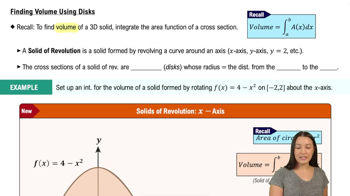
Finding Volume Using Disks

Setting up the Shell Radius and Height

When revolving around a line other than the coordinate axes, the radius of each shell is the distance from the shell to the axis of rotation. The height corresponds to the function's value or difference between bounding curves. Correctly expressing radius and height in terms of the variable of integration is crucial.
Video consigliato:
06:18
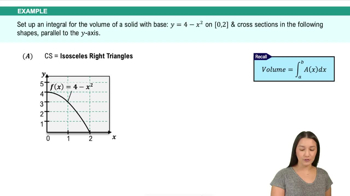
Introduction to Cross Sections Example 2

Region and Boundaries Identification

Understanding the region bounded by y = x², x = 1, and y = 0 is essential. This defines the limits of integration and the shape of the shells. Visualizing or sketching the region helps determine the integration bounds and the orientation of shells relative to the axis y = 2.
Video consigliato:
Percorso guidato
07:45
Area of Polar Regions