

Ch. 6 - Applications of Integration
Briggs - Calculus: Early Transcendentals 3rd Edition
Briggs3rd EditionCalculus: Early TranscendentalsISBN: 9780136847243Non è quello che usi tu?Cambia libro di testo
Capitolo 6, Problema 6.1.43a

40–43. Population growth


A culture of bacteria in a Petri dish has an initial population of 1500 cells and grows at a rate (in cells/day) of N′(t) = 100e^−0.25t. Assume t is measured in days.


a. What is the population after 20 days? After 40 days?

Guida verificata passo dopo passo
1
Identify the given rate of change of the population, which is the derivative of the population function: \(N\'(t) = 100e^{-0.25t}\), where \(t\) is in days.
Recognize that to find the population function \(N(t)\), you need to integrate the rate function \(N\'(t)\) with respect to \(t\): \(N(t) = \int 100e^{-0.25t} \, dt + C\).
Perform the integration of \(100e^{-0.25t}\): use the integral formula \(\int e^{kt} dt = \frac{1}{k} e^{kt} + C\), keeping track of the constant of integration \(C\).
Use the initial condition given, \(N(0) = 1500\), to solve for the constant \(C\) by substituting \(t=0\) into the integrated function and setting it equal to 1500.
Once you have the explicit formula for \(N(t)\), substitute \(t=20\) and \(t=40\) into this formula to find the population after 20 days and 40 days, respectively.

Risposta video verificata per un problema simile:

Questa soluzione video è stata consigliata dai nostri tutor come utile per risolvere questo problema.
Durata del video:
5m

Concetti chiave

Ecco i concetti essenziali che devi comprendere per rispondere correttamente alla domanda.

Derivative as Rate of Change

The derivative N′(t) represents the instantaneous rate of change of the population with respect to time. In this problem, N′(t) = 100e^−0.25t gives the growth rate in cells per day at any time t, which is essential for determining how the population changes over time.
Video consigliato:
Percorso guidato
04:16
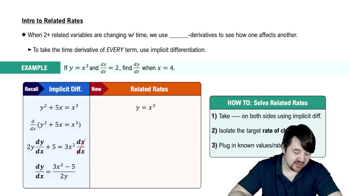
Intro To Related Rates

Definite Integral for Accumulated Change

To find the total change in population over a time interval, we integrate the rate function N′(t) from the start to the end time. The definite integral of N′(t) from 0 to t gives the net increase in population during that period.
Video consigliato:
Percorso guidato
05:43
Definition of the Definite Integral

Initial Condition and Population Function

The initial population N(0) = 1500 serves as the starting value for the population function N(t). After integrating the rate function, adding this initial value gives the total population at any time t, allowing calculation of population after 20 and 40 days.
Video consigliato:
Percorso guidato
05:03
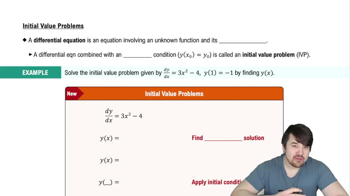
Initial Value Problems
Pratica correlata
Domanda del libro di testo

Emptying a conical tank A water tank is shaped like an inverted cone with height 6 m and base radius 1.5 m (see figure).

a. If the tank is full, how much work is required to pump the water to the level of the top of the tank and out of the tank?

154
views
Domanda del libro di testo

Flow rates in the Spokane River The daily discharge of the Spokane River as it flows through Spokane, Washington, in April and June is modeled by the functions

r1(t) = 0.25t²+37.46t+722.47 (April) and

r2(t) = 0.90t²−69.06t+2053.12 (June), where the discharge is measured in millions of cubic feet per day, and t=0 corresponds to the beginning of the first day of the month (see figure).

a. Determine the total amount of water that flows through Spokane in April (30 days). 

44
views
Domanda del libro di testo

Blood flow A typical human heart pumps 70 mL of blood (the stroke volume) with each beat. Assuming a heart rate of 60 beats/min (1 beat/s), a reasonable model for the outflow rate of the heart is V′(t)=70(1+sin 2πt), where V(t) is the amount of blood (in milliliters) pumped over the interval [0,t],V(0)=0 and t is measured in seconds.


a. Verify that the amount of blood pumped over a one-second interval is 70 mL.

162
views
Domanda del libro di testo

Region R is revolved about the line y=1 to form a solid of revolution.


a. What is the radius of a cross section of the solid at a point x in [0, 4]?

61
views
Domanda del libro di testo

Consider the region R in the first quadrant bounded by y=x^1/n and y=x^n, where n>1 is a positive number.


a. Find the volume V(n) of the solid generated when R is revolved about the x-axis. Express your answer in terms of n.

28
views
Domanda del libro di testo

For the given regions R₁ and R₂, complete the following steps.


a. Find the area of region R₁.


R₁ is the region in the first quadrant bounded by the y-axis and the curves y=2x^2 and y=3−x; R₂ is the region in the first quadrant bounded by the x-axis and the curves y=2x^2 and y=3−x(see figure).

47
views