Ch. 6 - Applications of Integration
Briggs - Calculus: Early Transcendentals 3rd Edition
Briggs3rd EditionCalculus: Early TranscendentalsISBN: 9780136847243Non è quello che usi tu?Cambia libro di testo
Capitolo 6, Problema 6.4.25

9-34. Shell method Let R be the region bounded by the following curves. Use the shell method to find the volume of the solid generated when R is revolved about indicated axis. 


{Use of Tech} y = 1 / (x² + 1)²,y=0,x=1, and x=2; about the y-axis

Guida verificata passo dopo passo
1
Identify the region R bounded by the curves: \( y = \frac{1}{(x^2 + 1)^2} \), \( y = 0 \), \( x = 1 \), and \( x = 2 \). This region lies between \( x = 1 \) and \( x = 2 \) above the x-axis and under the curve \( y = \frac{1}{(x^2 + 1)^2} \).
Since the solid is generated by revolving the region about the y-axis, use the shell method. The shell method formula for volume when revolving around the y-axis is: \[ V = 2\pi \int_{a}^{b} (\text{radius})(\text{height}) \, dx \] where the radius is the distance from the y-axis to the shell (which is \( x \)) and the height is the function value \( y = \frac{1}{(x^2 + 1)^2} \).
Set up the integral with the limits of integration from \( x = 1 \) to \( x = 2 \): \[ V = 2\pi \int_{1}^{2} x \cdot \frac{1}{(x^2 + 1)^2} \, dx \]
Simplify the integrand if possible. Here, the integrand is \( \frac{x}{(x^2 + 1)^2} \). Consider using substitution to evaluate the integral later, such as letting \( u = x^2 + 1 \), which implies \( du = 2x \, dx \).
After setting up the integral, proceed to evaluate it using the substitution method or other integration techniques. Finally, multiply the result by \( 2\pi \) to find the volume of the solid.

Risposta video verificata per un problema simile:

Questa soluzione video è stata consigliata dai nostri tutor come utile per risolvere questo problema.
Durata del video:
5m

Concetti chiave

Ecco i concetti essenziali che devi comprendere per rispondere correttamente alla domanda.

Shell Method for Volume

The shell method calculates the volume of a solid of revolution by integrating cylindrical shells. Each shell's volume is found by multiplying its circumference, height, and thickness. This method is especially useful when revolving a region around an axis parallel to the axis of the variable of integration.
Video consigliato:
04:48
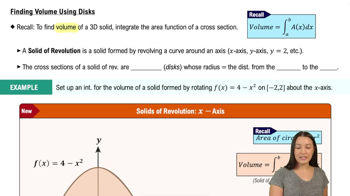
Finding Volume Using Disks

Setting up the Integral with Given Bounds

To apply the shell method, identify the radius and height of each shell based on the region's boundaries. Here, the radius is the distance from the y-axis (the axis of rotation) to x, and the height is given by the function y = 1/(x² + 1)². The bounds for x are from 1 to 2, defining the limits of integration.
Video consigliato:
05:06
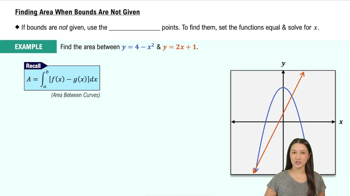
Finding Area When Bounds Are Not Given

Understanding the Function and Region

The function y = 1/(x² + 1)² describes the upper boundary of the region, while y = 0, x = 1, and x = 2 form the other boundaries. Recognizing these curves helps visualize the region being revolved and ensures correct interpretation of the height and limits in the integral.
Video consigliato:
Percorso guidato
07:45
Area of Polar Regions