Ch. 6 - Applications of Integration
Briggs - Calculus: Early Transcendentals 3rd Edition
Briggs3rd EditionCalculus: Early TranscendentalsISBN: 9780136847243Non è quello che usi tu?Cambia libro di testo
Capitolo 6, Problema 6.4.33

9-34. Shell method Let R be the region bounded by the following curves. Use the shell method to find the volume of the solid generated when R is revolved about indicated axis. 


y = x³−x⁸+1,y=1; about the y-axis

Guida verificata passo dopo passo
1
First, identify the region R bounded by the curves given: \(y = x^{3} - x^{8} + 1\) and \(y = 1\). Since the region is revolved about the y-axis, we will use the shell method with respect to \(x\).
Set up the shell radius and height. The radius of a typical shell is the distance from the y-axis, which is \(x\). The height of the shell is the vertical distance between the curves, which is \(y - 1 = (x^{3} - x^{8} + 1) - 1 = x^{3} - x^{8}\).
Determine the interval for \(x\) over which the region exists. Since the region is bounded by \(y = 1\) and \(y = x^{3} - x^{8} + 1\), find the values of \(x\) where these two curves intersect by solving \(x^{3} - x^{8} + 1 = 1\), which simplifies to \(x^{3} - x^{8} = 0\).
Express the volume integral using the shell method formula: \(V = 2\pi \int_{a}^{b} (\text{radius})(\text{height}) \, dx = 2\pi \int_{a}^{b} x (x^{3} - x^{8}) \, dx\) where \(a\) and \(b\) are the intersection points found in the previous step.
Simplify the integrand to \(x^{4} - x^{9}\) and set up the definite integral for volume: \(V = 2\pi \int_{a}^{b} (x^{4} - x^{9}) \, dx\). The final step would be to evaluate this integral to find the volume.

Risposta video verificata per un problema simile:

Questa soluzione video è stata consigliata dai nostri tutor come utile per risolvere questo problema.
Durata del video:
5m

Concetti chiave

Ecco i concetti essenziali che devi comprendere per rispondere correttamente alla domanda.

Shell Method for Volume

The shell method calculates the volume of a solid of revolution by integrating cylindrical shells. Each shell's volume is approximated by its circumference times height times thickness. When revolving around the y-axis, shells are vertical slices parallel to the axis, and the radius is the x-value of the shell.
Video consigliato:
04:48
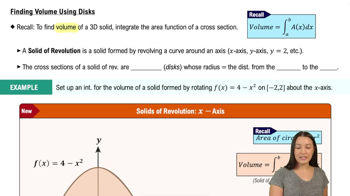
Finding Volume Using Disks

Setting up the Integral with Given Curves

To use the shell method, identify the region bounded by the curves y = x³ − x⁸ + 1 and y = 1. The height of each shell is the vertical distance between these curves, and the limits of integration correspond to the x-values where the region exists. Understanding the relationship between x and y is crucial.
Video consigliato:
05:23
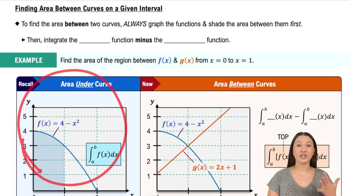
Finding Area Between Curves on a Given Interval

Revolution about the y-axis

Revolving a region about the y-axis means the shells are formed by rotating vertical slices around this axis. The radius of each shell is the horizontal distance from the y-axis to the slice, which equals the x-coordinate. This affects the integral's setup, as the radius function depends on x.
Video consigliato:
06:30
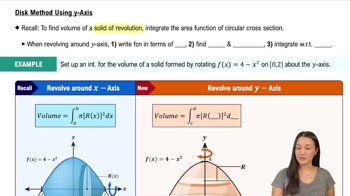
Disk Method Using y-Axis