
Ch. 6 - Applications of Integration
Briggs - Calculus: Early Transcendentals 3rd Edition
Briggs3rd EditionCalculus: Early TranscendentalsISBN: 9780136847243Non è quello che usi tu?Cambia libro di testo
Capitolo 6, Problema 6.5.9

9–20. Arc length calculations Find the arc length of the following curves on the given interval.
y = −8x−3 on [−2, 6] (Use calculus.)

Guida verificata passo dopo passo
1
Identify the function given: \(y = -8x - 3\) and the interval \([-2, 6]\) over which we want to find the arc length.
Recall the formula for the arc length \(L\) of a curve \(y = f(x)\) from \(x = a\) to \(x = b\): \(L = \int_{a}^{b} \sqrt{1 + \left(\frac{dy}{dx}\right)^2} \, dx\)
Compute the derivative \(\frac{dy}{dx}\) of the function \(y = -8x - 3\). Since this is a linear function, find \(\frac{dy}{dx}\) explicitly.
Substitute \(\frac{dy}{dx}\) into the arc length formula to get the integrand \(\sqrt{1 + \left(\frac{dy}{dx}\right)^2}\), which will be a constant expression because the derivative is constant.
Evaluate the definite integral \(\int_{-2}^{6} \sqrt{1 + \left(\frac{dy}{dx}\right)^2} \, dx\) by integrating the constant integrand over the interval length \((6 - (-2))\).

Risposta video verificata per un problema simile:

Questa soluzione video è stata consigliata dai nostri tutor come utile per risolvere questo problema.
Durata del video:
2m

Concetti chiave

Ecco i concetti essenziali che devi comprendere per rispondere correttamente alla domanda.

Arc Length Formula

The arc length of a curve y = f(x) from x = a to x = b is found using the integral formula L = ∫_a^b √(1 + (dy/dx)^2) dx. This formula sums the lengths of infinitesimal line segments along the curve, providing the total distance traveled along it.
Video consigliato:
Percorso guidato
06:29
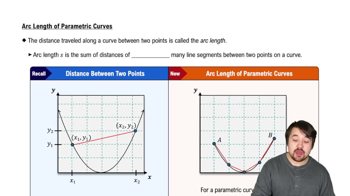
Arc Length of Parametric Curves

Derivative of the Function

To apply the arc length formula, you need the derivative dy/dx of the function y = f(x). The derivative represents the slope of the curve at any point, and its square is used inside the square root to account for the curve's steepness in the length calculation.
Video consigliato:
06:30
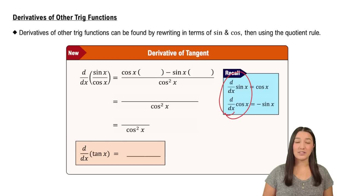
Derivatives of Other Trig Functions

Definite Integration

Calculating arc length requires evaluating a definite integral over the given interval [a, b]. This process involves integrating the expression √(1 + (dy/dx)^2) with respect to x, which may require algebraic simplification or substitution to solve.
Video consigliato:
Percorso guidato
05:43
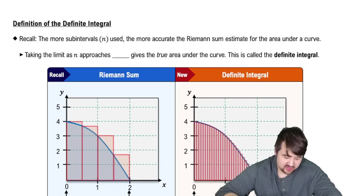
Definition of the Definite Integral
Pratica correlata
Domanda del libro di testo

9–12. Consider the cylindrical tank in Example 4 that has a height of 10 m and a radius of 5 m. Recall that if the tank is full of water, then ∫₀¹⁰ 25 π ρg(15−y) dy equals the work required to pump all the water out of the tank, through an outflow pipe that is 15 m above the bottom of the tank. Revise this work integral for the following scenarios. (Do not evaluate the integrals.)


The work required to empty the top half of the tank

91
views
Domanda del libro di testo

Leaky Bucket A 1-kg bucket resting on the ground contains 3 kg of water. How much work is required to raise the bucket vertically a distance of 10 m if water leaks out of the bucket at a constant rate of 1/5 kg/m? Assume the weight of the rope used to raise the bucket is negligible. (Hint: Use the definition of work, W = ∫a^bF(y) dy, where F is the variable force required to lift an object along a vertical line from y=a to y=b.)

72
views
Domanda del libro di testo

Find the area of the region described in the following exercises.


The region bounded by x=y(y−1) and y=x/3

64
views
Domanda del libro di testo

9-34. Shell method Let R be the region bounded by the following curves. Use the shell method to find the volume of the solid generated when R is revolved about indicated axis. 


{Use of Tech} y = √sin^−1x,y = √π/2, and x=0; about the x-axis

42
views
Domanda del libro di testo

For the following regions R, determine which is greater—the volume of the solid generated when R is revolved about the x-axis or about the y-axis.


R is bounded by y=1−x^3, the x-axis, and the y-axis.

100
views
Domanda del libro di testo

Let R be the region bounded by the following curves. Find the volume of the solid generated when R is revolved about the given line.


x=2−secy,x=2,y=π/3, and y=0; about x=2

163
views