
Ch. 6 - Applications of Integration
Briggs - Calculus: Early Transcendentals 3rd Edition
Briggs3rd EditionCalculus: Early TranscendentalsISBN: 9780136847243Non è quello che usi tu?Cambia libro di testo
Capitolo 6, Problema 6.3.2

A solid has a circular base; cross sections perpendicular to the base are squares. What method should be used to find the volume of the solid?

Guida verificata passo dopo passo
1
Identify the shape of the base and the cross sections: The base is a circle, and the cross sections perpendicular to the base are squares.
Set up a coordinate system to describe the base: For example, place the circle in the xy-plane with its center at the origin, so the equation of the base is \(x^2 + y^2 = r^2\) where \(r\) is the radius of the circle.
Express the side length of each square cross section in terms of \(x\): Since the cross sections are perpendicular to the base along the x-axis, the side length of the square at position \(x\) is the length of the chord of the circle at that \(x\), which is \(2y = 2\sqrt{r^2 - x^2}\).
Write the area of each square cross section as a function of \(x\): The area \(A(x)\) is the side length squared, so \(A(x) = \left(2\sqrt{r^2 - x^2}\right)^2\).
Set up the volume integral using the method of slicing: Integrate the area function \(A(x)\) along the interval covering the base, typically from \(-r\) to \(r\), so the volume \(V = \int_{-r}^{r} A(x) \, dx\).

Risposta video verificata per un problema simile:

Questa soluzione video è stata consigliata dai nostri tutor come utile per risolvere questo problema.
Durata del video:
2m

Concetti chiave

Ecco i concetti essenziali che devi comprendere per rispondere correttamente alla domanda.

Volume by Cross-Sectional Area

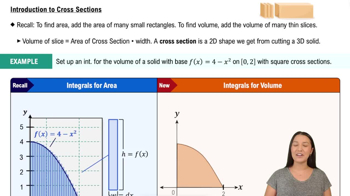
This method involves slicing the solid into thin cross sections perpendicular to an axis, finding the area of each cross section, and integrating these areas over the interval. The volume is the integral of the cross-sectional area function with respect to the variable along the axis.
Video consigliato:
05:38
Introduction to Cross Sections

Geometry of Cross Sections

Understanding the shape and dimensions of the cross sections is crucial. Here, the cross sections are squares whose side length depends on the radius of the circular base at that slice, linking the base geometry to the cross-sectional area.
Video consigliato:
Percorso guidato
3:08
Geometries from Conic Sections

Setting up the Integral Using the Base Radius

Since the base is circular, the radius function defines the side length of the square cross sections. Expressing the side length in terms of the variable (e.g., x or y) allows setting up the integral limits and the area function to compute the volume.
Video consigliato:
4:46
Solving Exponential Equations Using Like Bases