
Ch. 6 - Applications of Integration
Briggs - Calculus: Early Transcendentals 3rd Edition
Briggs3rd EditionCalculus: Early TranscendentalsISBN: 9780136847243Non è quello che usi tu?Cambia libro di testo
Capitolo 6, Problema 6.1.37c

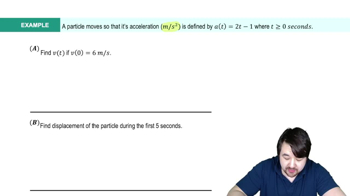
Acceleration A drag racer accelerates at a(t)=88 ft/s². Assume v(0)=0, s(0)=0, and t is measured in seconds.


c. At this rate, how long will it take the racer to travel 1/4 mi?

Guida verificata passo dopo passo
1
Identify the given acceleration function: \(a(t) = 88\) ft/s², which is constant.
Since acceleration is the derivative of velocity, integrate \(a(t)\) with respect to \(t\) to find the velocity function \(v(t)\): \[v(t) = \int a(t) \, dt = \int 88 \, dt = 88t + C_1\] Use the initial condition \(v(0) = 0\) to solve for \(C_1\).
Next, velocity is the derivative of position, so integrate \(v(t)\) to find the position function \(s(t)\): \[s(t) = \int v(t) \, dt = \int 88t \, dt = 44t^2 + C_2\] Use the initial condition \(s(0) = 0\) to solve for \(C_2\).
Convert the distance to consistent units: Since \(1\) mile = \(5280\) feet, \(\frac{1}{4}\) mile = \(\frac{1}{4} \times 5280 = 1320\) feet.
Set the position function equal to \(1320\) feet and solve for \(t\): \[44t^2 = 1320\] Solve this equation to find the time \(t\) it takes to travel \(\frac{1}{4}\) mile.

Risposta video verificata per un problema simile:

Questa soluzione video è stata consigliata dai nostri tutor come utile per risolvere questo problema.
Durata del video:
4m

Concetti chiave

Ecco i concetti essenziali che devi comprendere per rispondere correttamente alla domanda.

Acceleration and Its Relationship to Velocity and Displacement

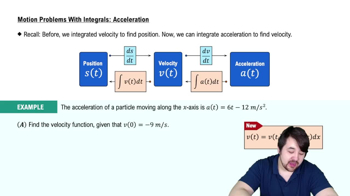
Acceleration is the rate of change of velocity with respect to time. Given a constant acceleration, velocity can be found by integrating acceleration over time, and displacement can be found by integrating velocity. This relationship allows us to determine how velocity and position evolve from acceleration.
Video consigliato:
Percorso guidato
08:56
Using The Acceleration Function Example 1

Integration of Constant Acceleration

When acceleration is constant, velocity increases linearly over time, and displacement follows a quadratic function of time. Specifically, velocity is a(t) multiplied by time plus initial velocity, and displacement is (1/2) times acceleration times time squared plus initial displacement.
Video consigliato:
Percorso guidato
08:14
Using The Acceleration Function

Unit Conversion and Distance Measurement

To solve for time when given a distance in miles, it is essential to convert miles to feet to match the units of acceleration (ft/s²). Since 1 mile equals 5280 feet, converting 1/4 mile to feet ensures consistent units for accurate calculation.
Video consigliato:
5:10
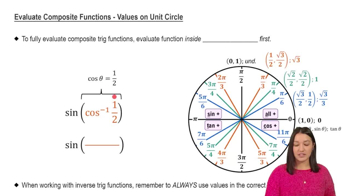
Evaluate Composite Functions - Values on Unit Circle
Pratica correlata
Domanda del libro di testo

Oscillating growth rates Some species have growth rates that oscillate with an (approximately) constant period P. Consider the growth rate function N'(t) = r+A sin 2πt/P, where A and r are constants with units of individuals/yr, and t is measured in years. A species becomes extinct if its population ever reaches 0 after t=0.


c. Suppose P=10, A=50, and r=5. If the initial population is N(0)=10, does the population ever become extinct? Explain.

42
views
Domanda del libro di testo

Region R is revolved about the line y=1 to form a solid of revolution.


c. Write an integral for the volume of the solid.

73
views
Domanda del libro di testo

Let R be the region bounded by the curve y=√cos x and the x-axis on [0, π/2]. A solid of revolution is obtained by revolving R about the x-axis (see figures). 


c. Write an integral for the volume of the solid.

64
views
Domanda del libro di testo

Explain why or why not Determine whether the following statements are true and give an explanation or counterexample.

c. The work required to lift a 10-kg object vertically 10 m is the same as the work required to lift a 20-kg object vertically 5 m.

49
views
Domanda del libro di testo

Blood flow A typical human heart pumps 70 mL of blood (the stroke volume) with each beat. Assuming a heart rate of 60 beats/min (1 beat/s), a reasonable model for the outflow rate of the heart is V′(t)=70(1+sin 2πt), where V(t) is the amount of blood (in milliliters) pumped over the interval [0,t],V(0)=0 and t is measured in seconds.


c. What is the cardiac output over a period of 1 min? (Use calculus; then check your answer with algebra.)

97
views
Domanda del libro di testo

9–10. Velocity graphs The figures show velocity functions for motion along a line. Assume the motion begins with an initial position of s(0)=0. Determine the following.

c. The position at t=5

40
views