

Ch. 6 - Applications of Integration
Briggs - Calculus: Early Transcendentals 3rd Edition
Briggs3rd EditionCalculus: Early TranscendentalsISBN: 9780136847243Non è quello che usi tu?Cambia libro di testo
Capitolo 6, Problema 6.6.27b

Consider the following curves on the given intervals.  


b. Use a calculator or software to approximate the surface area.


y=tan x , for 0≤x≤π/4; about the x-axis 

Guida verificata passo dopo passo
1
Step 1: Recall the formula for the surface area of a curve rotated about the x-axis. The formula is: S = 2π ∫[a,b] y √(1 + (dy/dx)^2) dx, where y is the function and dy/dx is its derivative.
Step 2: Identify the given function and interval. Here, y = tan(x) and the interval is [0, π/4]. Substitute y = tan(x) into the formula.
Step 3: Compute the derivative of y = tan(x). The derivative is dy/dx = sec^2(x). Substitute this into the formula for surface area.
Step 4: Simplify the integrand. The integrand becomes tan(x) √(1 + sec^4(x)). Set up the integral: S = 2π ∫[0,π/4] tan(x) √(1 + sec^4(x)) dx.
Step 5: Use a calculator or software to approximate the value of the integral numerically. This step involves evaluating the integral using numerical methods, as the integrand is complex and does not have a simple antiderivative.

Risposta video verificata per un problema simile:

Questa soluzione video è stata consigliata dai nostri tutor come utile per risolvere questo problema.
Durata del video:
2m

Concetti chiave

Ecco i concetti essenziali che devi comprendere per rispondere correttamente alla domanda.

Surface Area of Revolution

The surface area of revolution refers to the area of a surface created when a curve is rotated around an axis. For a function y = f(x) rotated about the x-axis, the formula involves integrating the circumference of infinitesimally thin circular slices of the surface. The formula is given by S = 2π ∫[a to b] f(x) √(1 + (f'(x))^2) dx, where f'(x) is the derivative of f(x).
Video consigliato:
09:07
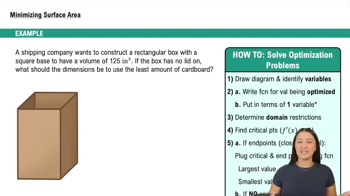
Example 1: Minimizing Surface Area

Integration

Integration is a fundamental concept in calculus that involves finding the accumulated area under a curve. It is the reverse process of differentiation and is used to calculate quantities such as area, volume, and surface area. In the context of surface area, definite integrals are used to sum up the contributions of each infinitesimal slice of the surface.
Video consigliato:
Percorso guidato
06:18
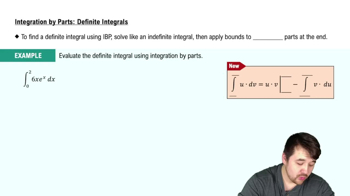
Integration by Parts for Definite Integrals

Trigonometric Functions

Trigonometric functions, such as tangent, sine, and cosine, relate the angles of a triangle to the lengths of its sides. The function y = tan(x) specifically represents the ratio of the opposite side to the adjacent side in a right triangle. Understanding the behavior of these functions, especially within specific intervals, is crucial for accurately calculating areas and understanding the shape of the curves involved.
Video consigliato:
Percorso guidato
6:04
Introduction to Trigonometric Functions
Pratica correlata
Domanda del libro di testo

In the design of solid objects (both artificial and natural), the ratio of the surface area to the volume of the object is important. Animals typically generate heat at a rate proportional to their volume and lose heat at a rate proportional to their surface area. Therefore, animals with a low SAV ratio tend to retain heat, whereas animals with a high SAV ratio (such as children and hummingbirds) lose heat relatively quickly.


b. What is the SAV ratio of a ball with radius a? 

42
views
Domanda del libro di testo

Use the region R that is bounded by the graphs of y=1+√x,x=4, and y=1 complete the exercises.


Region R is revolved about the y-axis to form a solid of revolution whose cross sections are washers.


b. What is the inner radius of a cross section of the solid at a point y in [1, 3]?

51
views
Domanda del libro di testo

40–43. Population growth


When records were first kept (t=0), the population of a rural town was 250 people. During the following years, the population grew at a rate of P′(t) = 30(1+√t), where t is measured in years.


b. Find the population P(t) at any time t≥0.

24
views
Domanda del libro di testo

9–10. Velocity graphs The figures show velocity functions for motion along a line. Assume the motion begins with an initial position of s(0)=0. Determine the following.

b. The distance traveled between t=0 and t=5

99
views
Domanda del libro di testo

Probe speed A data collection probe is dropped from a stationary balloon, and it falls with a velocity (in m/s) given by v(t) = 9.8t, neglecting air resistance. After 10 s, a chute deploys and the probe immediately slows to a constant speed of 10 m/s, which it maintains until it enters the ocean.


b. How far does the probe fall in the first 30 s after it is released?

43
views
Domanda del libro di testo

Volume of a sphere Let R be the region bounded by the upper half of the circle x²+y² = r² and the x-axis. A sphere of radius r is obtained by revolving R about the x-axis.


b. Repeat part (a) using the disk method.

79
views