Ch. 6 - Applications of Integration
Briggs - Calculus: Early Transcendentals 3rd Edition
Briggs3rd EditionCalculus: Early TranscendentalsISBN: 9780136847243Non è quello che usi tu?Cambia libro di testo
Capitolo 6, Problema 6.1.47a

Depletion of natural resources Suppose r(t) = r0e^−kt, with k>0, is the rate at which a nation extracts oil, where r0=10⁷ barrels/yr is the current rate of extraction. Suppose also that the estimate of the total oil reserve is 2×10⁹ barrels. 


a. Find Q(t), the total amount of oil extracted by the nation after t years.

Guida verificata passo dopo passo
1
Identify the given rate of extraction function: \(r(t) = r_0 e^{-kt}\), where \(r_0 = 10^7\) barrels/year and \(k > 0\).
Recall that \(Q(t)\), the total amount of oil extracted after \(t\) years, is the integral of the rate function \(r(t)\) from 0 to \(t\): \(Q(t) = \int_0^t r(\tau) \, d\tau\).
Substitute the given rate function into the integral: \(Q(t) = \int_0^t r_0 e^{-k\tau} \, d\tau\).
Integrate the exponential function with respect to \(\tau\): \(\int e^{-k\tau} \, d\tau = -\frac{1}{k} e^{-k\tau} + C\).
Apply the definite integral limits from 0 to \(t\) and multiply by \(r_0\): \(Q(t) = r_0 \left[-\frac{1}{k} e^{-k\tau} \right]_0^t = r_0 \left(-\frac{1}{k} e^{-kt} + \frac{1}{k} e^{0} \right)\).

Risposta video verificata per un problema simile:

Questa soluzione video è stata consigliata dai nostri tutor come utile per risolvere questo problema.
Durata del video:
3m

Concetti chiave

Ecco i concetti essenziali che devi comprendere per rispondere correttamente alla domanda.

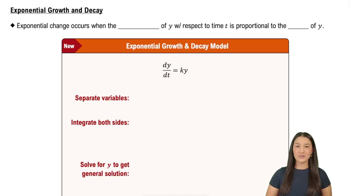
Exponential Decay Function

An exponential decay function models quantities that decrease at a rate proportional to their current value. In this problem, the extraction rate r(t) = r0e^(-kt) shows how the oil extraction rate decreases over time, with k > 0 controlling the speed of decay.
Video consigliato:
09:29
Exponential Growth & Decay

Definite Integral for Accumulated Quantity

To find the total amount extracted over time, we integrate the rate function r(t) from 0 to t. The definite integral sums the instantaneous extraction rates, giving the cumulative quantity Q(t) extracted after t years.
Video consigliato:
Percorso guidato
05:43
Definition of the Definite Integral

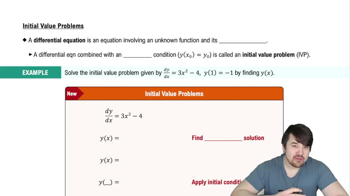
Initial Conditions and Parameters

Understanding the given constants, such as the initial extraction rate r0 and the total reserve, is crucial. These parameters set the scale and constraints for the problem, ensuring the solution is physically meaningful and consistent with the resource limits.
Video consigliato:
Percorso guidato
05:03
Initial Value Problems
Pratica correlata
Domanda del libro di testo

55–58. Marginal cost Consider the following marginal cost functions.


a. Find the additional cost incurred in dollars when production is increased from 100 units to 150 units.


C′(x) = 300+10x−0.01x²

89
views

Domanda del libro di testo

6–8. Let R be the region bounded by the curves y = 2−√x,y=2, and x=4 in the first quadrant.


Suppose the shell method is used to determine the volume of the solid generated by revolving R about the line x=4.


a. What is the radius of a cylindrical shell at a point x in [0, 4]?

59
views
Domanda del libro di testo

{Use of Tech} Oscillating motion A mass hanging from a spring is set in motion, and its ensuing velocity is given by v(t) = 2π cos πt, for t≥0. Assume the positive direction is upward and s(0)=0. 


a. Determine the position function, for t≥0.

68
views
Domanda del libro di testo

Emptying a water trough A water trough has a semicircular cross section with a radius of 0.25 m and a length of 3 m (see figure).

a. How much work is required to pump the water out of the trough (to the level of the top of the trough) when it is full?

65
views
Domanda del libro di testo

A vertical spring A 10-kg mass is attached to a spring that hangs vertically and is stretched 2 m from the equilibrium position of the spring. Assume a linear spring with F(x) = kx.

a. How much work is required to compress the spring and lift the mass 0.5 m?

62
views
Domanda del libro di testo

17–22. Position from velocity Consider an object moving along a line with the given velocity v and initial position.


a. Determine the position function, for t≥0, using the antiderivative method


v(t) = 6−2t on [0, 5]; s(0)=0

50
views