Ch. 6 - Applications of Integration
Briggs - Calculus: Early Transcendentals 3rd Edition
Briggs3rd EditionCalculus: Early TranscendentalsISBN: 9780136847243Non è quello che usi tu?Cambia libro di testo
Capitolo 6, Problema 6.2.71

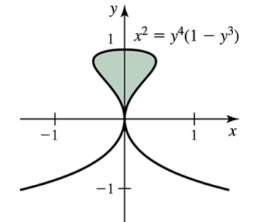
Determine the area of the shaded region bounded by the curve x^2=y^4(1−y^3) (see figure).
fig

Guida verificata passo dopo passo
1
Step 1: Analyze the given equation x^2 = y^4(1 - y^3). The shaded region is symmetric about the y-axis, so we can calculate the area for y in [0, 1] and double it to account for symmetry.
Step 2: Express x in terms of y. Since x^2 = y^4(1 - y^3), the curve is symmetric about the y-axis, and we can focus on the positive x values. Thus, x = sqrt(y^4(1 - y^3)).
Step 3: Set up the integral for the area. The area of the shaded region is given by the integral of x with respect to y over the interval [0, 1]. The integral becomes A = 2 * ∫[0 to 1] sqrt(y^4(1 - y^3)) dy.
Step 4: Simplify the integrand. Rewrite sqrt(y^4(1 - y^3)) as y^2 * sqrt(1 - y^3) to make the integral easier to handle.
Step 5: Solve the integral. Use substitution to evaluate the integral. Let u = 1 - y^3, then du = -3y^2 dy. Adjust the limits of integration accordingly and proceed to compute the integral.

Risposta video verificata per un problema simile:

Questa soluzione video è stata consigliata dai nostri tutor come utile per risolvere questo problema.
Durata del video:
4m

Concetti chiave

Ecco i concetti essenziali che devi comprendere per rispondere correttamente alla domanda.

Implicit Functions

The equation x² = y⁴(1 - y³) defines a relationship between x and y, where y is expressed implicitly as a function of x. Understanding implicit functions is crucial for analyzing curves that cannot be easily solved for one variable in terms of another. This concept is foundational in calculus, particularly when dealing with curves and their properties.
Video consigliato:
Percorso guidato
05:14
Finding The Implicit Derivative

Area Under a Curve

Calculating the area of a shaded region bounded by a curve involves integrating the function that describes the curve. In this case, the area can be found by setting up an integral with appropriate limits based on the intersection points of the curve with the axes. This concept is essential for understanding how to quantify regions in the Cartesian plane.
Video consigliato:
Percorso guidato
05:59
Estimating the Area Under a Curve with Right Endpoints & Midpoint

Symmetry in Graphs

The given curve exhibits symmetry about the y-axis, which can simplify the calculation of the area. Recognizing symmetry allows us to compute the area of one side of the curve and then double it, reducing the complexity of the problem. This concept is particularly useful in calculus when dealing with even functions or symmetric shapes.
Video consigliato:
Percorso guidato
06:15
Graphing The Derivative