

Ch. 6 - Applications of Integration
Briggs - Calculus: Early Transcendentals 3rd Edition
Briggs3rd EditionCalculus: Early TranscendentalsISBN: 9780136847243Non è quello che usi tu?Cambia libro di testo
Capitolo 6, Problema 6.5.2

Explain the steps required to find the length of a curve x = g(y) between y=c and y=d.

Guida verificata passo dopo passo
1
Step 1: Recall the formula for the length of a curve. The length of a curve defined as x = g(y) between y = c and y = d is given by the integral: ∫cd1+(dxdy)2dy.
Step 2: Compute the derivative dx/dy. To find the derivative of x with respect to y, differentiate the function x = g(y) with respect to y. This will give you dxdy.
Step 3: Square the derivative dx/dy. Once you have computed dxdy, square it to obtain (dxdy)2.
Step 4: Substitute into the formula. Replace the squared derivative and the constant 1 into the square root part of the formula: 1+(dxdy)2.
Step 5: Evaluate the integral. Integrate the expression 1+(dxdy)2 with respect to y from y = c to y = d to find the length of the curve.

Risposta video verificata per un problema simile:

Questa soluzione video è stata consigliata dai nostri tutor come utile per risolvere questo problema.
Durata del video:
2m

Concetti chiave

Ecco i concetti essenziali che devi comprendere per rispondere correttamente alla domanda.

Parametric Representation of Curves

In calculus, curves can be represented parametrically, where one variable is expressed in terms of another. For the curve defined by x = g(y), y serves as the parameter. This representation allows us to analyze the curve's properties, such as its length, by integrating with respect to the parameter.
Video consigliato:
Percorso guidato
06:49
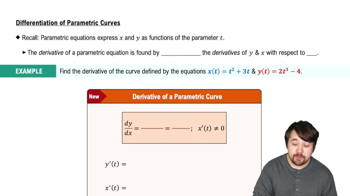
Differentiation of Parametric Curves

Arc Length Formula

The arc length of a curve defined by a function can be calculated using the formula L = ∫√(1 + (dx/dy)²) dy. Here, dx/dy is the derivative of x with respect to y, which measures the rate of change of x as y varies. This formula accounts for the infinitesimal changes in both x and y, providing the total length of the curve between specified limits.
Video consigliato:
Percorso guidato
06:29
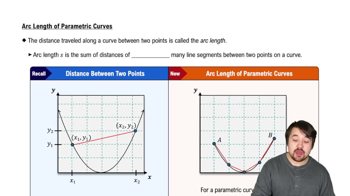
Arc Length of Parametric Curves

Definite Integrals

Definite integrals are used to calculate the total accumulation of a quantity over an interval. In the context of finding the length of a curve, the limits of integration (c and d) define the segment of the curve being measured. Evaluating the definite integral gives the exact length of the curve between these two points, incorporating the contributions of all infinitesimal segments.
Video consigliato:
Percorso guidato
05:43
Definition of the Definite Integral