Ch. 6 - Applications of Integration
Briggs - Calculus: Early Transcendentals 3rd Edition
Briggs3rd EditionCalculus: Early TranscendentalsISBN: 9780136847243Non è quello che usi tu?Cambia libro di testo
Capitolo 6, Problema 6.1.59b

Explain why or why not Determine whether the following statements are true and give an explanation or counterexample.


b. When the velocity is positive on an interval, the displacement and the distance traveled on that interval are equal.

Guida verificata passo dopo passo
1
Recall the definitions: displacement on an interval is the net change in position, calculated as \(s(b) - s(a)\) where \(s(t)\) is the position function, and distance traveled is the total length of the path traveled, which accounts for all movement regardless of direction.
Understand that velocity being positive on an interval means the object is moving forward (increasing position) throughout that interval, so \(v(t) > 0\) for all \(t\) in the interval.
Since velocity is positive, the position function \(s(t)\) is strictly increasing on that interval, meaning the object never moves backward.
Because the object only moves forward, the displacement (net change in position) equals the total distance traveled, as there are no backward movements to add extra distance.
Therefore, when velocity is positive on an interval, displacement and distance traveled on that interval are indeed equal.

Risposta video verificata per un problema simile:

Questa soluzione video è stata consigliata dai nostri tutor come utile per risolvere questo problema.
Durata del video:
2m

Concetti chiave

Ecco i concetti essenziali che devi comprendere per rispondere correttamente alla domanda.

Velocity and Its Significance

Velocity is the rate of change of position with respect to time and includes direction, indicated by its sign. A positive velocity means the object is moving in the positive direction, which affects how displacement and distance are calculated over an interval.
Video consigliato:
Percorso guidato
06:29
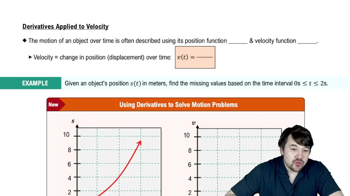
Derivatives Applied To Velocity

Displacement vs. Distance Traveled

Displacement is the net change in position from the start to the end of an interval, considering direction, while distance traveled is the total length of the path covered, always non-negative. They are equal only if the motion does not change direction.
Video consigliato:
Percorso guidato
08:56
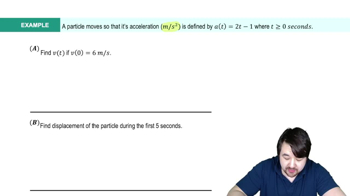
Using The Acceleration Function Example 1

Relationship Between Velocity and Displacement/Distance

If velocity remains positive over an interval, the object moves continuously in one direction, so displacement equals distance traveled. However, if velocity changes sign, displacement and distance differ, highlighting the importance of velocity's sign in comparing these quantities.
Video consigliato:
Percorso guidato
06:29
Derivatives Applied To Velocity
Pratica correlata
Domanda del libro di testo

Equal integrals Without evaluating integrals, explain the following equalities. (Hint: Draw pictures.)


b. ∫²₀(25−(x²+1)²) dx = 2∫₁⁵ y√y−1 dy

110
views

Domanda del libro di testo

Calculating work for different springs Calculate the work required to stretch the following springs 0.4 m from their equilibrium positions. Assume Hooke’s law is obeyed.

b. A spring that requires 2 J of work to be stretched 0.1 m from its equilibrium position

82
views
Domanda del libro di testo

Deceleration A car slows down with an acceleration of a(t) = −15 ft/s². Assume v(0)=60 ft/s,s(0)=0, and t is measured in seconds.


b. How far does the car travel in the time it takes to come to rest?

31
views
Domanda del libro di testo

13–16. Displacement from velocity Consider an object moving along a line with the given velocity v. Assume time t is measured in seconds and velocities have units of m/s.


b. Find the displacement over the given interval. 


v(t) = 3t²−6t on [0, 3]

32
views
Domanda del libro di testo

40–43. Population growth


When records were first kept (t=0), the population of a rural town was 250 people. During the following years, the population grew at a rate of P′(t) = 30(1+√t), where t is measured in years.


b. Find the population P(t) at any time t≥0.

24
views
Domanda del libro di testo

9–10. Velocity graphs The figures show velocity functions for motion along a line. Assume the motion begins with an initial position of s(0)=0. Determine the following.

b. The distance traveled between t=0 and t=5

99
views