

Ch. 6 - Applications of Integration
Briggs - Calculus: Early Transcendentals 3rd Edition
Briggs3rd EditionCalculus: Early TranscendentalsISBN: 9780136847243Non è quello che usi tu?Cambia libro di testo
Capitolo 6, Problema 6.6.9

Find the area of the surface generated when the given curve is revolved about the given axis.


y=8√x, for 9≤x≤20; about the x-axis

Guida verificata passo dopo passo
1
Step 1: Recall the formula for the surface area of a curve revolved about the x-axis. The formula is: S = 2π ∫ab y √(1 + (dy/dx)2) dx, where y is the function being revolved, and dy/dx is its derivative.
Step 2: Identify the given function y = 8√x and compute its derivative dy/dx. Using the power rule, dy/dx = 8 * (1/2) * x-1/2 = 4x-1/2.
Step 3: Substitute y = 8√x and dy/dx = 4x-1/2 into the surface area formula. This gives: S = 2π ∫920 (8√x) √(1 + (4x-1/2)2) dx.
Step 4: Simplify the expression inside the square root. Compute (4x-1/2)2 = 16x-1, so the integrand becomes: S = 2π ∫920 (8√x) √(1 + 16x-1) dx.
Step 5: Set up the integral for evaluation. The integral is now ready to be computed either analytically or numerically: S = 2π ∫920 (8√x) √(1 + 16/x) dx. Break this into manageable parts or use numerical methods to evaluate the integral.

Risposta video verificata per un problema simile:

Questa soluzione video è stata consigliata dai nostri tutor come utile per risolvere questo problema.
Durata del video:
5m

Concetti chiave

Ecco i concetti essenziali che devi comprendere per rispondere correttamente alla domanda.

Surface Area of Revolution

The surface area of revolution is calculated by rotating a curve around an axis. The formula involves integrating the length of the curve multiplied by the radius of rotation. For a curve y=f(x) revolved around the x-axis, the surface area S can be expressed as S = 2π ∫[a to b] f(x) √(1 + (f'(x))^2) dx, where f'(x) is the derivative of f(x).
Video consigliato:
09:07
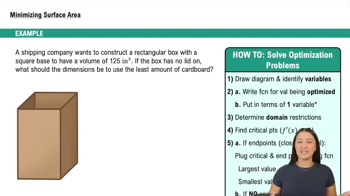
Example 1: Minimizing Surface Area

Parametric Representation

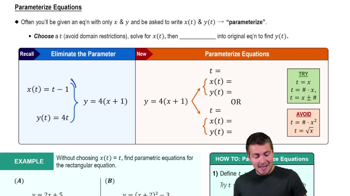
In some cases, curves can be represented parametrically, which involves expressing the coordinates of points on the curve as functions of a parameter. For the curve y=8√x, it can be useful to express x in terms of a parameter t, where t=x, to facilitate integration. This representation helps in calculating derivatives and applying the surface area formula effectively.
Video consigliato:
08:02
Parameterizing Equations

Definite Integral

A definite integral calculates the accumulation of quantities, such as area, over a specific interval. In this context, the limits of integration (9 to 20) define the section of the curve being revolved. Understanding how to evaluate definite integrals is crucial for finding the total surface area generated by the revolution of the curve around the x-axis.
Video consigliato:
Percorso guidato
05:43
Definition of the Definite Integral