Ch. 6 - Applications of Integration
Briggs - Calculus: Early Transcendentals 3rd Edition
Briggs3rd EditionCalculus: Early TranscendentalsISBN: 9780136847243Non è quello che usi tu?Cambia libro di testo
Capitolo 6, Problema 6.R.11a

{Use of Tech} Decreasing velocity A projectile is fired upward, and its velocity in m/s is given by v(t) = 200e^−t/10, for t≥0.
a. Graph the velocity function, for t≥0.

Guida verificata passo dopo passo
1
Understand the velocity function: The given function is v(t) = 200e^(-t/10), where v(t) represents the velocity of the projectile at time t. The function is an exponential decay function, indicating that the velocity decreases over time.
Identify the key features of the function: The initial velocity at t = 0 is v(0) = 200e^(0) = 200 m/s. As t increases, the term e^(-t/10) decreases, causing the velocity to decrease.
Determine the behavior of the function as t approaches infinity: As t becomes very large, e^(-t/10) approaches 0, which means the velocity v(t) approaches 0 m/s.
Choose an appropriate range for t: Since the problem specifies t ≥ 0, consider a range of t values from 0 to a reasonable upper limit, such as 50 seconds, to observe the behavior of the velocity over time.
Plot the graph: On a graph, plot v(t) on the y-axis and t on the x-axis. Start at the point (0, 200) and show the curve decreasing towards the x-axis as t increases, reflecting the exponential decay of the velocity.

Risposta video verificata per un problema simile:

Questa soluzione video è stata consigliata dai nostri tutor come utile per risolvere questo problema.
Durata del video:
3m

Concetti chiave

Ecco i concetti essenziali che devi comprendere per rispondere correttamente alla domanda.

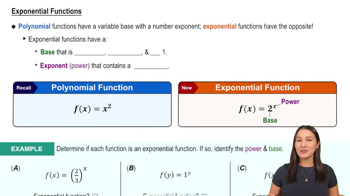
Exponential Functions

Exponential functions are mathematical expressions in the form of f(t) = a * e^(kt), where 'e' is the base of natural logarithms. In the context of the given velocity function v(t) = 200e^(-t/10), the negative exponent indicates that the function decreases over time, which is typical for projectile motion as it loses velocity due to gravity.
Video consigliato:
6:13
Exponential Functions

Graphing Functions

Graphing functions involves plotting points on a coordinate system to visualize the relationship between variables. For the velocity function v(t) = 200e^(-t/10), the graph will show how the velocity decreases as time increases, illustrating the projectile's deceleration. Understanding how to interpret and create these graphs is essential for analyzing motion.
Video consigliato:
Percorso guidato
5:53
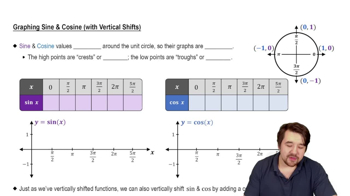
Graph of Sine and Cosine Function

Velocity and Time Relationship

The relationship between velocity and time in projectile motion describes how the speed of an object changes over time. In this case, the velocity function indicates that as time progresses, the velocity of the projectile decreases exponentially, reflecting the effects of gravitational pull. This concept is crucial for understanding the dynamics of motion in physics.
Video consigliato:
Percorso guidato
06:29
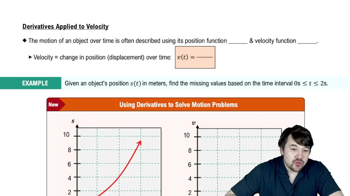
Derivatives Applied To Velocity
Pratica correlata
Domanda del libro di testo

27–33. Multiple regions The regions R₁,R₂, and R₃ (see figure) are formed by the graphs of y = 2√x,y = 3−x,and x=3.

Find the area of each of the regions R₁,R₂, and R₃.

58
views

Domanda del libro di testo

Area and volume The region R is bounded by the curves x = y²+2,y=x−4, and y=0 (see figure).

a. Write a single integral that gives the area of R.

152
views
Domanda del libro di testo

Force on a dam Find the total force on the face of a semicircular dam with a radius of 20 m when its reservoir is full of water. The diameter of the semicircle is the top of the dam.

63
views
Domanda del libro di testo

Comparing volumes Let R be the region bounded by y=1/x^p and the x-axis on the interval [1, a], where p>0 and a>1 (see figure). Let Vₓ and Vᵧ be the volumes of the solids generated when R is revolved about the x- and y-axes, respectively.


c. Find a general expression for Vₓ in terms of a and p. Note that p=1/2 is a special case. What is Vₓ when p=1/2?

60
views
Domanda del libro di testo

27–33. Multiple regions The regions R₁,R₂, and R₃ (see figure) are formed by the graphs of y = 2√x,y = 3−x,and x=3.


Use the shell method to find an integral, or sum of integrals, that equals the volume of the solid obtained by revolving region R₃ about the line x=3. Do not evaluate the integral.

48
views
Domanda del libro di testo

43–55. Volumes of solids Choose the general slicing method, the disk/washer method, or the shell method to answer the following questions.


The region bounded by the graph of y = 4−x² and the x-axis on the interval [−2,2] is revolved about the line x = −2. What is the volume of the solid that is generated?

80
views