
Ch. 6 - Applications of Integration
Briggs - Calculus: Early Transcendentals 3rd Edition
Briggs3rd EditionCalculus: Early TranscendentalsISBN: 9780136847243Non è quello che usi tu?Cambia libro di testo
Capitolo 6, Problema 6.1.68b

Variable gravity At Earth’s surface, the acceleration due to gravity is approximately g=9.8 m/s² (with local variations). However, the acceleration decreases with distance from the surface according to Newton’s law of gravitation. At a distance of y meters from Earth’s surface, the acceleration is given by a(y) = - g / (1+y/R)², where R=6.4×10⁶ m is the radius of Earth.


b. Use the Chain Rule to show that dv/dt = 1/2 d/dy(v²).

Guida verificata passo dopo passo
1
Recall that velocity \(v\) is a function of time \(t\), and position \(y\) is also a function of time \(t\). Therefore, \(v = \frac{dy}{dt}\) and \(v\) can be considered as \(v(y(t))\).
Start with the expression \(\frac{d}{dt}(v^2)\). Using the Chain Rule, this derivative can be written as \(\frac{d}{dt}(v^2) = \frac{d}{dy}(v^2) \cdot \frac{dy}{dt}\).
Since \(\frac{dy}{dt} = v\), substitute this into the expression to get \(\frac{d}{dt}(v^2) = \frac{d}{dy}(v^2) \cdot v\).
Now, solve for \(\frac{dv}{dt}\) by differentiating \(v^2 = (v)^2\) with respect to \(t\): \(\frac{d}{dt}(v^2) = 2v \frac{dv}{dt}\).
Equate the two expressions for \(\frac{d}{dt}(v^2)\): \(2v \frac{dv}{dt} = \frac{d}{dy}(v^2) \cdot v\). Divide both sides by \$2v$ (assuming \(v \neq 0\)) to isolate \(\frac{dv}{dt}\), yielding \(\frac{dv}{dt} = \frac{1}{2} \frac{d}{dy}(v^2)\).

Risposta video verificata per un problema simile:

Questa soluzione video è stata consigliata dai nostri tutor come utile per risolvere questo problema.
Durata del video:
3m

Concetti chiave

Ecco i concetti essenziali che devi comprendere per rispondere correttamente alla domanda.

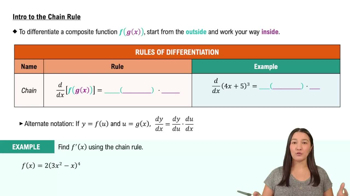
Chain Rule

The Chain Rule is a fundamental differentiation technique used to compute the derivative of a composite function. It states that if a variable depends on an intermediate variable, which in turn depends on another variable, the derivative is the product of the derivatives along the chain. In this problem, it helps relate derivatives with respect to time and position.
Video consigliato:
05:02
Intro to the Chain Rule

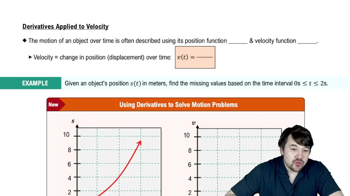
Relationship Between Velocity and Position

Velocity (v) is the rate of change of position (y) with respect to time (t), expressed as v = dy/dt. This relationship allows us to connect derivatives with respect to time and position, which is essential when applying the Chain Rule to rewrite dv/dt in terms of derivatives with respect to y.
Video consigliato:
Percorso guidato
06:29
Derivatives Applied To Velocity

Derivative of a Function Squared

When differentiating the square of a function, such as v², the power rule combined with the Chain Rule applies: d/dy(v²) = 2v dv/dy. Recognizing this helps transform expressions involving dv/dt into forms involving d/dy(v²), facilitating the proof requested in the question.
Video consigliato:
06:30
Derivatives of Other Trig Functions
Pratica correlata
Domanda del libro di testo

For the given regions R₁ and R₂, complete the following steps.


b. Find the area of region R₂ using geometry and the answer to part (a).


R₁is the region in the first quadrant bounded by the line x=1 and the curve y=6x(2−x^2)^2; R₂ is the region in the first quadrant bounded the curve y=6x(2−x^2)^2and the line y=6x.

40
views
Domanda del libro di testo

Determine whether the following statements are true and give an explanation or counterexample.


b. The area of the region between y=sin x and y=cos x on the interval [0,π/2] is ∫π/20(cosx−sinx)dx.

45
views
Domanda del libro di testo

40–43. Population growth


Starting with an initial value of P(0)=55, the population of a prairie dog community grows at a rate of P′(t)=20−t/5 (prairie dogs/month), for 0≤t≤200, where t is measured in months.


b. Find the population P(t), for 0≤t≤200.

22
views
Domanda del libro di testo

Two runners At noon (t=0), Alicia starts running along a long straight road at 4 mi/hr. Her velocity decreases according to the function v(t) = 4 / t + 1 for t≥0. At noon, Boris also starts running along the same road with a 2-mi head start on Alicia; his velocity is given by u(t) = 2 / t + 1, for t≥0. Assume t is measured in hours.


b. When, if ever, does Alicia overtake Boris?

45
views
Domanda del libro di testo

Filling a tank A 2000-liter cistern is empty when water begins flowing into it (at t=0 at a rate (in L/min) given by Q′(t) = 3√t, where t is measured in minutes.


b. Find the function that gives the amount of water in the tank at any time t≥0.

45
views
Domanda del libro di testo

Cycling distance A cyclist rides down a long straight road with a velocity (in m/min) given by v(t) = 400−20t, for 0≤t≤10, where t is measured in minutes.


b. How far does the cyclist travel in the first 10 min?

49
views