
Domanda del libro di testo
Find the area of the surface generated when the given curve is revolved about the given axis.
x=√12y−y^2, for 2≤y≤10; about the y-axis
119
views

 Guida verificata passo dopo passo
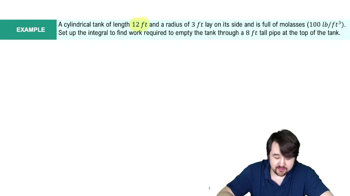
 11:50
11:50
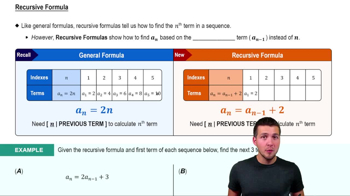 5:59
5:59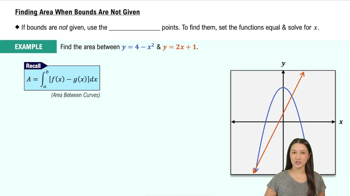 05:06
05:06Find the area of the surface generated when the given curve is revolved about the given axis.
x=√12y−y^2, for 2≤y≤10; about the y-axis
Find the area of the surface generated when the given curve is revolved about the given axis.
y=x^3/2−x^1/2 / 3, for 1≤x≤2; about the x-axis
Explain how to find the mass of a one-dimensional object with a variable density ρ.
Use the general slicing method to find the volume of the following solids.
The solid whose base is the triangle with vertices (0, 0), (2, 0), and (0, 2), and whose cross sections perpendicular to the base and parallel to the y-axis are semicircles
Let R be the region bounded by the following curves. Find the volume of the solid generated when R is revolved about the given axis.
y=2x,y=0 , and x=3; about the x-axis (Verify that your answer agrees with the volume formula for a cone.)
For the following regions R, determine which is greater—the volume of the solid generated when R is revolved about the x-axis or about the y-axis.
R is bounded by y=4−2x, the x-axis, and the y-axis.