Ch. 7 - Logarithmic, Exponential Functions, and Hyperbolic Functions
Briggs - Calculus: Early Transcendentals 3rd Edition
Briggs3rd EditionCalculus: Early TranscendentalsISBN: 9780136847243Non è quello che usi tu?Cambia libro di testo
Capitolo 7, Problema 7.3.35

22–36. Derivatives Find the derivatives of the following functions.


f(x) = x sinh⁻¹ x − √(x² + 1)

Guida verificata passo dopo passo
1
Step 1: Recognize that the function f(x) = x sinh⁻¹(x) − √(x² + 1) involves the inverse hyperbolic sine function (sinh⁻¹(x)) and a square root term. To find the derivative, we will apply the product rule, chain rule, and the derivative of inverse hyperbolic functions.
Step 2: Recall the derivative of sinh⁻¹(x), which is d/dx [sinh⁻¹(x)] = 1 / √(x² + 1). Also, recall the derivative of √(x² + 1), which is d/dx [√(x² + 1)] = (1 / (2√(x² + 1))) * d/dx [x² + 1] = x / √(x² + 1).
Step 3: Apply the product rule to the term x sinh⁻¹(x). The product rule states that d/dx [u(x)v(x)] = u'(x)v(x) + u(x)v'(x). Here, u(x) = x and v(x) = sinh⁻¹(x). Compute u'(x) = 1 and v'(x) = 1 / √(x² + 1). Substitute these into the product rule.
Step 4: Differentiate the second term, −√(x² + 1), using the chain rule. As derived earlier, the derivative of √(x² + 1) is x / √(x² + 1). Therefore, the derivative of −√(x² + 1) is −x / √(x² + 1).
Step 5: Combine all the results. The derivative of f(x) is f'(x) = [1 * sinh⁻¹(x) + x * (1 / √(x² + 1))] − (x / √(x² + 1)). Simplify the expression to get the final derivative.

Risposta video verificata per un problema simile:

Questa soluzione video è stata consigliata dai nostri tutor come utile per risolvere questo problema.
Durata del video:
4m

Concetti chiave

Ecco i concetti essenziali che devi comprendere per rispondere correttamente alla domanda.

Derivatives

A derivative represents the rate of change of a function with respect to its variable. It is a fundamental concept in calculus that provides information about the slope of the tangent line to the function's graph at any given point. The derivative can be computed using various rules, such as the power rule, product rule, and chain rule, depending on the form of the function.
Video consigliato:

Inverse Hyperbolic Functions

The inverse hyperbolic sine function, denoted as sinh⁻¹(x), is the inverse of the hyperbolic sine function. It is defined for all real numbers and is useful in calculus for finding derivatives and integrals involving hyperbolic functions. Understanding how to differentiate inverse hyperbolic functions is essential for solving problems that involve them.
Video consigliato:
Percorso guidato
5:50
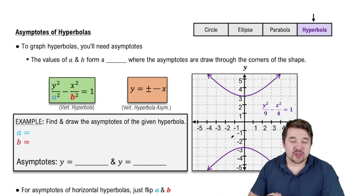
Asymptotes of Hyperbolas

Square Root Function

The square root function, represented as √(x² + 1), is a common mathematical function that returns the non-negative square root of its argument. When differentiating this function, the chain rule is often applied, as it involves a composition of functions. Recognizing how to handle square roots in differentiation is crucial for accurately finding derivatives of more complex expressions.
Video consigliato: