Ch. 7 - Logarithmic, Exponential Functions, and Hyperbolic Functions
Briggs - Calculus: Early Transcendentals 3rd Edition
Briggs3rd EditionCalculus: Early TranscendentalsISBN: 9780136847243Non è quello che usi tu?Cambia libro di testo
Capitolo 7, Problema 7.3.105

Inverse identity Show that cosh⁻¹(cosh x) = |x| by using the formula cosh⁻¹ t = ln (t + √(t² – 1)) and considering the cases x ≥ 0 and x < 0.

Guida verificata passo dopo passo
1
Recall the definition of the inverse hyperbolic cosine function: \(\cosh^{-1} t = \ln \left(t + \sqrt{t^2 - 1} \right)\) for \(t \geq 1\).
Substitute \(t = \cosh x\) into the formula to get \(\cosh^{-1}(\cosh x) = \ln \left( \cosh x + \sqrt{\cosh^2 x - 1} \right)\).
Use the identity \(\cosh^2 x - 1 = \sinh^2 x\) to rewrite the expression as \(\ln \left( \cosh x + |\sinh x| \right)\).
Consider the two cases separately: - For \(x \geq 0\), \(\sinh x \geq 0\), so \(|\sinh x| = \sinh x\). - For \(x < 0\), \(\sinh x < 0\), so \(|\sinh x| = -\sinh x\).
Evaluate the expression in each case: - When \(x \geq 0\), \(\ln (\cosh x + \sinh x) = \ln (e^x) = x\). - When \(x < 0\), \(\ln (\cosh x - \sinh x) = \ln (e^{-x}) = -x = |x|\). Thus, \(\cosh^{-1}(\cosh x) = |x|\).

Risposta video verificata per un problema simile:

Questa soluzione video è stata consigliata dai nostri tutor come utile per risolvere questo problema.
Durata del video:
4m

Concetti chiave

Ecco i concetti essenziali che devi comprendere per rispondere correttamente alla domanda.

Inverse Hyperbolic Cosine Function

The inverse hyperbolic cosine, denoted as cosh⁻¹(t), is the function that returns the value x such that cosh(x) = t for t ≥ 1. It is defined by the formula cosh⁻¹(t) = ln(t + √(t² – 1)), which expresses the inverse in terms of natural logarithms and square roots.
Video consigliato:
4:49
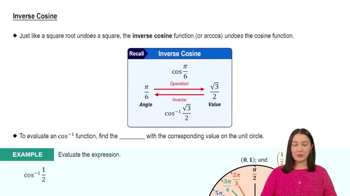
Inverse Cosine

Properties of the Hyperbolic Cosine Function

The hyperbolic cosine function, cosh(x), is an even function, meaning cosh(x) = cosh(–x). It is always greater than or equal to 1 and increases exponentially for large |x|. This symmetry is key to understanding why cosh⁻¹(cosh x) equals the absolute value of x.
Video consigliato:
Percorso guidato
06:21
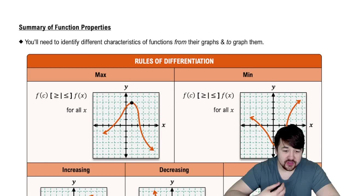
Properties of Functions

Piecewise Analysis Based on Domain

To prove cosh⁻¹(cosh x) = |x|, it is essential to consider two cases: x ≥ 0 and x < 0. Since cosh is even, analyzing these cases separately helps show that the inverse function returns x when x is nonnegative and –x when x is negative, resulting in the absolute value.
Video consigliato:
Percorso guidato
05:36
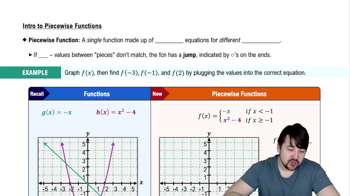
Piecewise Functions
Pratica correlata
Domanda del libro di testo

Population of Texas Texas was the third fastest growing state in the United States in 2016. Texas grew from 25.1 million in 2010 to 26.47 million in 2016. Use an exponential growth model to predict the population of Texas in 2025.

53
views
Domanda del libro di testo

Express sinh⁻¹ x in terms of logarithms.

169
views
Domanda del libro di testo

How does the graph of the catenary y = a cosh x/a change as a > 0 increases?

151
views
Domanda del libro di testo

22–36. Derivatives Find the derivatives of the following functions.


f(x) = cosh²x

83
views
Domanda del libro di testo

39–40. LED lighting LED (light-emitting diode) bulbs are rapidly decreasing in cost, and they are more energy-efficient than standard incandescent light bulbs and CFL (compact fluorescent light) bulbs. By some estimates, LED bulbs last more than 40 times longer than incandescent bulbs and more than 8 times longer than CFL bulbs. Haitz’s law, which is explored in the following two exercises, predicts that over time, LED bulbs will exponentially increase in efficiency and exponentially decrease in cost.


Haitz’s law predicts that the cost per lumen of an LED bulb decreases by a factor of 10 every 10 years. This means that 10 years from now, the cost of an LED bulb will be 1/10 of its current cost. Predict the cost of a particular LED bulb in 2021 if it costs 4 dollars in 2018.

51
views
Domanda del libro di testo

29–62. Integrals Evaluate the following integrals. Include absolute values only when needed.


∫ 3^{-2x} dx

43
views