Ch. 7 - Logarithmic, Exponential Functions, and Hyperbolic Functions
Briggs - Calculus: Early Transcendentals 3rd Edition
Briggs3rd EditionCalculus: Early TranscendentalsISBN: 9780136847243Non è quello che usi tu?Cambia libro di testo
Capitolo 7, Problema 7.1.68

Logarithm properties Use the integral definition of the natural logarithm to prove that ln(x/y) = ln x - ln y.

Guida verificata passo dopo passo
1
Recall the integral definition of the natural logarithm: for any positive number \( a \), \( \ln a = \int_1^a \frac{1}{t} \, dt \).
Express \( \ln \left( \frac{x}{y} \right) \) using the integral definition: \( \ln \left( \frac{x}{y} \right) = \int_1^{\frac{x}{y}} \frac{1}{t} \, dt \).
Use a substitution to rewrite the integral with limits from 1 to \( x \) and 1 to \( y \). Let \( t = \frac{u}{y} \), so that when \( t = 1 \), \( u = y \), and when \( t = \frac{x}{y} \), \( u = x \).
Rewrite the integral in terms of \( u \): \( \int_1^{\frac{x}{y}} \frac{1}{t} \, dt = \int_y^x \frac{1}{\frac{u}{y}} \cdot \frac{1}{y} \, du = \int_y^x \frac{y}{u} \cdot \frac{1}{y} \, du = \int_y^x \frac{1}{u} \, du \).
Split the integral \( \int_y^x \frac{1}{u} \, du \) into \( \int_1^x \frac{1}{u} \, du - \int_1^y \frac{1}{u} \, du \), which equals \( \ln x - \ln y \), thus proving \( \ln \left( \frac{x}{y} \right) = \ln x - \ln y \).

Risposta video verificata per un problema simile:

Questa soluzione video è stata consigliata dai nostri tutor come utile per risolvere questo problema.
Durata del video:
3m

Concetti chiave

Ecco i concetti essenziali che devi comprendere per rispondere correttamente alla domanda.

Integral Definition of the Natural Logarithm

The natural logarithm ln(x) can be defined as the integral from 1 to x of 1/t dt. This definition provides a fundamental way to understand ln(x) using calculus, linking logarithms to areas under curves.
Video consigliato:
Percorso guidato
05:43
Definition of the Definite Integral

Properties of Definite Integrals

Definite integrals have properties such as additivity over adjacent intervals and the ability to split or combine integrals. These properties allow manipulation of integrals to express ln(x/y) in terms of ln(x) and ln(y).
Video consigliato:
Percorso guidato
05:43
Definition of the Definite Integral

Logarithm Laws and Their Proofs

Logarithm laws, like ln(x/y) = ln(x) - ln(y), describe relationships between logarithms of products and quotients. Using the integral definition and integral properties, these laws can be rigorously proven rather than assumed.
Video consigliato:
7:30
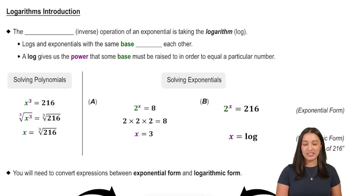
Logarithms Introduction
Pratica correlata
Domanda del libro di testo

Catenary arch The portion of the curve y =17/15 - cosh x that lies above the x-axis forms a catenary arch. Find the average height of the arch above the x-axis.

31
views

Domanda del libro di testo

15–20. Designing exponential growth functions Complete the following steps for the given situation.


a. Find the rate constant k and use it to devise an exponential growth function that fits the given data.

b. Answer the accompanying question.


Savings account An initial deposit of \$1500 is placed in a savings account with an APY of 3.1%. How long will it take until the balance of the account is \$2500? Assume the interest rate remains constant and no additional deposits or withdrawals are made.

82
views
Domanda del libro di testo

29–62. Integrals Evaluate the following integrals. Include absolute values only when needed.


∫₀^{π} 2^{sin x} · cos x dx

60
views
Domanda del libro di testo

29–62. Integrals Evaluate the following integrals. Include absolute values only when needed.


∫₁ᵉ^² (ln x)^5 / x dx

62
views
Domanda del libro di testo

Derivative of ln|x| Differentiate ln x, for x > 0, and differentiate ln(−x), for x < 0, to conclude that d/dx (ln|x|) = 1/x

194
views
Domanda del libro di testo

15–20. Designing exponential growth functions Complete the following steps for the given situation.


a. Find the rate constant k and use it to devise an exponential growth function that fits the given data.

b. Answer the accompanying question.


Population The population of Clark County, Nevada, was about 2.115 million in 2015. Assuming an annual growth rate of 1.5%/yr, what will the county population be in 2025?

67
views