
Atmospheric pressure The pressure of Earth’s atmosphere at sea level is approximately 1000 millibars and decreases exponentially with elevation. At an elevation of 30,000 ft (approximately the altitude of Mt. Everest), the pressure is one-third the sea-level pressure. At what elevation is the pressure half the sea-level pressure? At what elevation is it 1% of the sea-level pressure?
Ch. 7 - Logarithmic, Exponential Functions, and Hyperbolic Functions
Briggs3rd EditionCalculus: Early TranscendentalsISBN: 9780136847243Non è quello che usi tu?Cambia libro di testo
Tutti i libri di testo
Briggs 3rd Edition
Ch. 7 - Logarithmic, Exponential Functions, and Hyperbolic Functions
Problema 7.3.8
Briggs 3rd Edition
Ch. 7 - Logarithmic, Exponential Functions, and Hyperbolic Functions
Problema 7.3.8Capitolo 7, Problema 7.3.8
On what interval is the formula d/dx (tanh⁻¹ x) = 1/(1 - x²) valid?
Guida verificata passo dopo passo1
Step 1: Recall the domain of the inverse hyperbolic tangent function, tanh⁻¹(x). The function tanh⁻¹(x) is defined for values of x in the interval (-1, 1), as the hyperbolic tangent function tanh(x) maps the real numbers to the interval (-1, 1).
Step 2: Analyze the derivative formula d/dx (tanh⁻¹ x) = 1/(1 - x²). For this formula to be valid, the denominator (1 - x²) must not be zero, as division by zero is undefined.
Step 3: Solve the inequality 1 - x² ≠ 0 to determine where the formula is valid. This simplifies to x² ≠ 1, which means x ≠ ±1.
Step 4: Combine the domain of tanh⁻¹(x) and the restriction from the derivative formula. The domain of tanh⁻¹(x) is (-1, 1), and the derivative formula is valid as long as x ≠ ±1. Since ±1 are already excluded from the domain of tanh⁻¹(x), the formula is valid on the entire interval (-1, 1).
Step 5: Conclude that the interval on which the formula d/dx (tanh⁻¹ x) = 1/(1 - x²) is valid is (-1, 1).

Risposta video verificata per un problema simile:
Questa soluzione video è stata consigliata dai nostri tutor come utile per risolvere questo problema.
Durata del video:
1mConcetti chiave
Ecco i concetti essenziali che devi comprendere per rispondere correttamente alla domanda.
Inverse Hyperbolic Functions
The inverse hyperbolic function tanh⁻¹ x, also known as the hyperbolic arctangent, is defined as the inverse of the hyperbolic tangent function. It is used to find the value of x such that tanh(y) = x. Understanding its domain and range is crucial for determining where its derivative is valid.
Video consigliato:
Percorso guidato
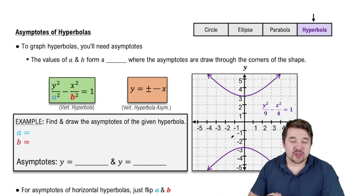
Asymptotes of Hyperbolas
Derivative of Inverse Functions
The derivative of an inverse function can be found using the formula d/dx (f⁻¹(x)) = 1/(f'(f⁻¹(x))). For tanh⁻¹ x, the derivative is given as 1/(1 - x²). This relationship highlights how the behavior of the original function influences the derivative of its inverse.
Video consigliato:
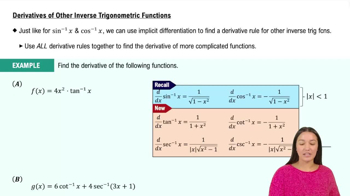
Derivatives of Other Inverse Trigonometric Functions
Domain of the Derivative
The expression 1/(1 - x²) is valid as long as the denominator is not zero, which occurs when x² = 1. Therefore, the derivative is defined for all x except x = 1 and x = -1. This means the interval of validity for the derivative of tanh⁻¹ x is (-1, 1), where the function remains continuous and differentiable.
Video consigliato:
Percorso guidato
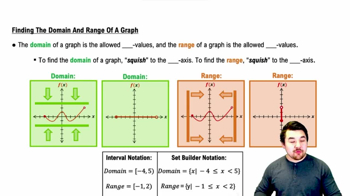
Finding the Domain and Range of a Graph
Pratica correlata
Domanda del libro di testo
160
views
Domanda del libro di testo
7–28. Derivatives Evaluate the following derivatives.
d/dx (x^{π})
68
views
Domanda del libro di testo
Bounds on e Use a left Riemann sum with at least n = 2 subintervals of equal length to approximate ln 2 = ∫[1 to 2] (dt/t) and show that ln 2 < 1. Use a right Riemann sum with n = 7 subintervals of equal length to approximate ln 3 = ∫[1 to 3] (dt/t) and show that ln 3 > 1.
30
views
Domanda del libro di testo
Evaluate ∫ 4ˣ dx.
72
views
Domanda del libro di testo
22–36. Derivatives Find the derivatives of the following functions.
f(x) = sinh 4x
75
views
Domanda del libro di testo
Evaluate the following derivatives.
d/dx (x^{x¹⁰})
63
views