
Ch. 8 - Integration Techniques
Briggs - Calculus: Early Transcendentals 3rd Edition
Briggs3rd EditionCalculus: Early TranscendentalsISBN: 9780136847243Non è quello che usi tu?Cambia libro di testo
Capitolo 8, Problema 8.5.20

17-22. Give the partial fraction decomposition for the following expressions.
20. (x² - 4x + 11) / ((x - 3)(x - 1)(x + 1))

Guida verificata passo dopo passo
1
Identify the form of the partial fraction decomposition. Since the denominator is a product of three distinct linear factors \((x - 3)\), \((x - 1)\), and \((x + 1)\), the decomposition will be of the form: \[\frac{A}{x - 3} + \frac{B}{x - 1} + \frac{C}{x + 1}\]
Write the equation equating the original fraction to the sum of partial fractions: \[\frac{x^{2} - 4x + 11}{(x - 3)(x - 1)(x + 1)} = \frac{A}{x - 3} + \frac{B}{x - 1} + \frac{C}{x + 1}\]
Multiply both sides of the equation by the common denominator \((x - 3)(x - 1)(x + 1)\) to clear the denominators: \[x^{2} - 4x + 11 = A(x - 1)(x + 1) + B(x - 3)(x + 1) + C(x - 3)(x - 1)\]
Expand each product on the right-hand side and combine like terms to express the right side as a polynomial in \(x\): - Expand \(A(x - 1)(x + 1)\) - Expand \(B(x - 3)(x + 1)\) - Expand \(C(x - 3)(x - 1)\) Then combine all terms to get a polynomial in the form $Px^{2} + Qx + R$.
Set the coefficients of corresponding powers of \(x\) on both sides equal to each other to form a system of equations: - Coefficient of \(x^{2}\): Left side equals Right side - Coefficient of \(x\): Left side equals Right side - Constant term: Left side equals Right side Solve this system for \(A\), \(B\), and \(C\).

Risposta video verificata per un problema simile:

Questa soluzione video è stata consigliata dai nostri tutor come utile per risolvere questo problema.
Durata del video:
7m

Concetti chiave

Ecco i concetti essenziali che devi comprendere per rispondere correttamente alla domanda.

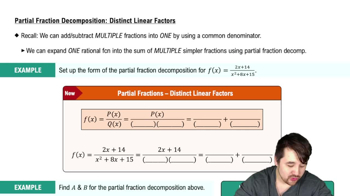
Partial Fraction Decomposition

Partial fraction decomposition is a technique used to express a rational function as a sum of simpler fractions with linear or quadratic denominators. This method is especially useful for integrating rational functions or simplifying expressions. The goal is to rewrite the given fraction into a form where each term has a simpler denominator.
Video consigliato:
Percorso guidato
10:07
Partial Fraction Decomposition: Distinct Linear Factors

Factoring the Denominator

Factoring the denominator into linear or irreducible quadratic factors is essential before performing partial fraction decomposition. In this problem, the denominator is already factored as (x - 3)(x - 1)(x + 1), which allows us to set up the decomposition with terms corresponding to each linear factor.
Video consigliato:
06:11
Limits of Rational Functions: Denominator = 0

Setting Up and Solving for Coefficients

After expressing the rational function as a sum of fractions with unknown coefficients, you multiply both sides by the common denominator to clear fractions. Then, equate coefficients of corresponding powers of x or substitute convenient x-values to solve for the unknown constants, completing the decomposition.
Video consigliato:
5:02
Solving Logarithmic Equations