Ch. 8 - Integration Techniques
Briggs - Calculus: Early Transcendentals 3rd Edition
Briggs3rd EditionCalculus: Early TranscendentalsISBN: 9780136847243Non è quello che usi tu?Cambia libro di testo
Capitolo 8, Problema 8.R.54

2–74. Integration techniques Use the methods introduced in Sections 8.1 through 8.5 to evaluate the following integrals.
54. ∫ dx/√(9x² - 25), x > 5/3

Guida verificata passo dopo passo
1
Step 1: Recognize the integral's form. The integrand resembles the structure of a trigonometric substitution problem, specifically involving a square root of a quadratic expression. The denominator √(9x² - 25) suggests using a substitution based on the identity for secant: sec²θ - 1 = tan²θ.
Step 2: Rewrite the quadratic expression in the form suitable for substitution. Factor out the constant 9 from the square root: √(9x² - 25) = √(9(x² - 25/9)) = 3√(x² - (5/3)²). This reveals the structure of a difference of squares, which is ideal for trigonometric substitution.
Step 3: Perform the substitution. Let x = (5/3)secθ, which implies dx = (5/3)secθtanθ dθ. Substituting into the integral, the square root √(9x² - 25) becomes 3√((5/3)²sec²θ - (5/3)²) = 3(5/3)tanθ = 5tanθ.
Step 4: Simplify the integral using the substitution. The integral ∫ dx/√(9x² - 25) transforms into ∫ ((5/3)secθtanθ dθ) / (5tanθ). Cancel out the common terms, leaving ∫ (1/3)secθ dθ.
Step 5: Evaluate the simplified integral. The integral of secθ is a standard result: ∫ secθ dθ = ln|secθ + tanθ| + C. Substitute back θ in terms of x using the original substitution x = (5/3)secθ to express the final result in terms of x.

Risposta video verificata per un problema simile:

Questa soluzione video è stata consigliata dai nostri tutor come utile per risolvere questo problema.
Durata del video:
2m

Concetti chiave

Ecco i concetti essenziali che devi comprendere per rispondere correttamente alla domanda.

Integration Techniques

Integration techniques are methods used to find the integral of a function. Common techniques include substitution, integration by parts, and partial fractions. Understanding these methods is crucial for solving complex integrals, as they allow for simplification and manipulation of the integrand to make integration feasible.
Video consigliato:
Percorso guidato
06:18
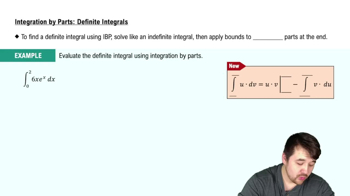
Integration by Parts for Definite Integrals

Trigonometric Substitution

Trigonometric substitution is a technique used to simplify integrals involving square roots of quadratic expressions. By substituting a variable with a trigonometric function, such as using x = a sin(θ) or x = a sec(θ), the integral can often be transformed into a more manageable form. This method is particularly useful for integrals like ∫ dx/√(ax² - b²).
Video consigliato:
Percorso guidato
6:04
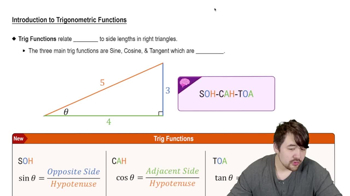
Introduction to Trigonometric Functions

Definite vs. Indefinite Integrals

Definite integrals calculate the area under a curve between two specific limits, while indefinite integrals represent a family of functions without limits. Understanding the difference is essential for applying the correct techniques and interpreting the results. In this problem, recognizing that the integral is indefinite helps in determining the appropriate method for evaluation.
Video consigliato:
Percorso guidato
05:43
Definition of the Definite Integral