

Ch. 8 - Integration Techniques
Briggs - Calculus: Early Transcendentals 3rd Edition
Briggs3rd EditionCalculus: Early TranscendentalsISBN: 9780136847243Non è quello che usi tu?Cambia libro di testo
Capitolo 8, Problema 8.8.41a

41-44. {Use of Tech} Nonuniform grids
Use the indicated methods to solve the following problems with nonuniform grids.
fig
41. A curling iron is plugged into an outlet at time t = 0. Its temperature T in degrees Fahrenheit, assumed to be a continuous function that is strictly increasing and concave down on 0 ≤ t ≤ 120, is given at various times (in seconds) in the table.
a. Approximate (1/120)∫(0 to 120)T(t)dt in three ways using a left Riemann sum, using a right Riemann sum and using the Trapezoid Rule
Interpret the value of (1/120)∫(0 to 120)T(t)dt in the context of this problem.

Guida verificata passo dopo passo
1
Step 1: Understand the problem. We are tasked with approximating the average temperature of the curling iron over the interval [0, 120] seconds using three methods: Left Riemann Sum, Right Riemann Sum, and the Trapezoid Rule. The integral (1/120)∫(0 to 120)T(t)dt represents the average temperature over the interval.
Step 2: For the Left Riemann Sum, use the temperature values at the left endpoints of each subinterval. Multiply each temperature value by the width of its corresponding subinterval, then sum these products. The subinterval widths are nonuniform: Δt = 20, 25, 15, 30, 20, 10 seconds. The formula is: (1/120) * [Δt₁*T(0) + Δt₂*T(20) + Δt₃*T(45) + Δt₄*T(60) + Δt₅*T(90) + Δt₆*T(110)].
Step 3: For the Right Riemann Sum, use the temperature values at the right endpoints of each subinterval. Multiply each temperature value by the width of its corresponding subinterval, then sum these products. The formula is: (1/120) * [Δt₁*T(20) + Δt₂*T(45) + Δt₃*T(60) + Δt₄*T(90) + Δt₅*T(110) + Δt₆*T(120)].
Step 4: For the Trapezoid Rule, average the left and right endpoint values for each subinterval, multiply by the width of the subinterval, and sum these products. The formula is: (1/120) * [Δt₁*(T(0) + T(20))/2 + Δt₂*(T(20) + T(45))/2 + Δt₃*(T(45) + T(60))/2 + Δt₄*(T(60) + T(90))/2 + Δt₅*(T(90) + T(110))/2 + Δt₆*(T(110) + T(120))/2].
Step 5: Interpret the result. The value of (1/120)∫(0 to 120)T(t)dt represents the average temperature of the curling iron over the interval [0, 120] seconds. This gives an idea of how hot the curling iron was on average during the heating process.

Risposta video verificata per un problema simile:

Questa soluzione video è stata consigliata dai nostri tutor come utile per risolvere questo problema.
Durata del video:
7m

Concetti chiave

Ecco i concetti essenziali che devi comprendere per rispondere correttamente alla domanda.

Riemann Sums

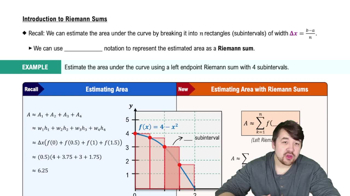
Riemann sums are a method for approximating the integral of a function over an interval by dividing the interval into subintervals and summing the areas of rectangles formed. The left Riemann sum uses the left endpoints of the subintervals, while the right Riemann sum uses the right endpoints. This technique helps estimate the area under the curve, which is essential for understanding the average value of a function over a specified range.
Video consigliato:
Percorso guidato
06:11
Introduction to Riemann Sums

Trapezoid Rule

The Trapezoid Rule is a numerical method for estimating the definite integral of a function. It approximates the area under the curve by dividing the interval into subintervals and approximating the area under the curve with trapezoids instead of rectangles. This method generally provides a more accurate estimate than Riemann sums, especially for functions that are continuous and smooth, as it accounts for the slope of the function between the endpoints.
Video consigliato:
5:50
Power Rules

Average Value of a Function

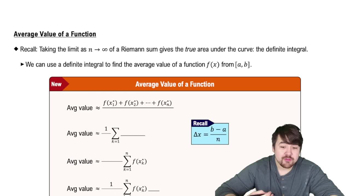
The average value of a continuous function over an interval [a, b] is given by the formula (1/(b-a))∫(a to b) f(x) dx. In this context, (1/120)∫(0 to 120) T(t) dt represents the average temperature of the curling iron over the first 120 seconds. Understanding this concept is crucial for interpreting the results of the Riemann sums and the Trapezoid Rule in the context of the problem, as it provides insight into the overall behavior of the temperature function.
Video consigliato:
Percorso guidato
06:37
Average Value of a Function
Pratica correlata
Domanda del libro di testo

Gamma function The gamma function is defined by Γ(p) = ∫ from 0 to ∞ of x^(p-1) e^(-x) dx, for p not equal to zero or a negative integer.

a. Use the reduction formula ∫ from 0 to ∞ of x^p e^(-x) dx = p ∫ from 0 to ∞ of x^(p-1) e^(-x) dx for p = 1, 2, 3, ...

to show that Γ(p + 1) = p! (p factorial).

109
views
Domanda del libro di testo

65. Explain why or why not Determine whether the following statements are true and give an explanation or counterexample.

a. To evaluate ∫ (4x⁶)/(x⁴ + 3x²) dx, the first step is to find the partial fraction decomposition of the integrand.

48
views
Domanda del libro di testo

A piece of wood paneling must be cut in the shape shown in the figure.

The coordinates of several points on its curved surface are also shown (with units of inches).

a. Estimate the surface area of the paneling using the Trapezoid Rule.

37
views
Domanda del libro di testo

66–71. {Use of Tech} Estimating error Refer to Theorem 8.1 in the following exercises.

70. Let f(x) = e^(-x²).

a. Find a Simpson's Rule approximation to the integral from 0 to 3 of e^(-x²) dx using n = 30 subintervals.

41
views
Domanda del libro di testo

66–71. {Use of Tech} Estimating error Refer to Theorem 8.1 in the following exercises.

69. Let f(x) = sin(eˣ).

a. Find a Trapezoid Rule approximation to ∫[0 to 1] sin(eˣ) dx using n = 40 subintervals.

48
views
Domanda del libro di testo

42. Approximating integrals The function f is twice differentiable on (-∞, ∞). Values of f at various points on [0, 20] are given in the table.

a. Approximate ∫(0 to 120) f(x) dx in three way using a left Riemann sum, a right Riemann sum and the Trapezoid Rule

58
views