Ch. 8 - Integration Techniques
Briggs - Calculus: Early Transcendentals 3rd Edition
Briggs3rd EditionCalculus: Early TranscendentalsISBN: 9780136847243Non è quello che usi tu?Cambia libro di testo
Capitolo 8, Problema 8.5.66

66-68. Areas of regions (Use of Tech) Find the area of the following regions.
66. The region bounded by the curve y = (x - x²)/[(x + 1)(x² + 1)] and the x-axis from x = 0 to x = 1

Guida verificata passo dopo passo
1
Identify the function to integrate: \( y = \frac{(x - x^{2})}{(x + 1)(x^{2} + 1)} \). We want to find the area between this curve and the x-axis from \( x = 0 \) to \( x = 1 \).
Set up the definite integral for the area: \[ \text{Area} = \int_{0}^{1} \left| \frac{(x - x^{2})}{(x + 1)(x^{2} + 1)} \right| \, dx \]. Since area is always positive, we take the absolute value of the function inside the integral.
Determine where the function \( y \) changes sign on the interval \( [0,1] \) by solving \( y = 0 \). This means solving \( x - x^{2} = 0 \) because the denominator is always positive for \( x \geq 0 \). The roots are \( x = 0 \) and \( x = 1 \), so check the sign of \( y \) between these points to see if the function is positive or negative.
If the function does not change sign between 0 and 1, you can remove the absolute value and integrate \( y \) directly. Otherwise, split the integral at the points where \( y = 0 \) and integrate the absolute value accordingly.
Use technology (such as a graphing calculator or computer algebra system) to evaluate the definite integral(s) set up in the previous step to find the exact area.

Risposta video verificata per un problema simile:

Questa soluzione video è stata consigliata dai nostri tutor come utile per risolvere questo problema.
Durata del video:
11m

Concetti chiave

Ecco i concetti essenziali che devi comprendere per rispondere correttamente alla domanda.

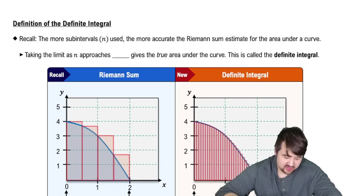
Definite Integral for Area Calculation

The definite integral of a function over an interval [a, b] represents the net area between the curve and the x-axis. When the function is positive, the integral gives the area directly; if negative, it subtracts area. To find the total area bounded by the curve and the x-axis, one may need to consider absolute values or split the integral at points where the function crosses the axis.
Video consigliato:
Percorso guidato
05:43
Definition of the Definite Integral

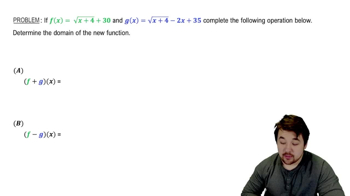
Analyzing the Sign of the Function

Before integrating, it is important to determine where the function is positive or negative within the interval. This helps in correctly calculating the area, as areas below the x-axis contribute negatively to the integral. Identifying zeros of the function within the interval allows splitting the integral accordingly.
Video consigliato:
Percorso guidato
4:46
Adding & Subtracting Functions Example 1

Use of Technology in Integration

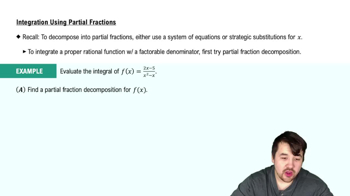
Complex rational functions like y = (x - x²)/[(x + 1)(x² + 1)] may be difficult to integrate by hand. Technology tools such as graphing calculators or computer algebra systems can assist in evaluating definite integrals accurately and efficiently, as well as in visualizing the function to understand its behavior over the interval.
Video consigliato:
Percorso guidato
08:01
Integration Using Partial Fractions