Ch. 8 - Integration Techniques
Briggs - Calculus: Early Transcendentals 3rd Edition
Briggs3rd EditionCalculus: Early TranscendentalsISBN: 9780136847243Non è quello che usi tu?Cambia libro di testo
Capitolo 8, Problema 8.4.36

7-56. Trigonometric substitutions Evaluate the following integrals using trigonometric substitution.
36. ∫[8√2 to 16] 1/√(x² - 64) dx

Guida verificata passo dopo passo
1
Step 1: Recognize that the integral involves a square root of the form √(x² - a²), which suggests using the trigonometric substitution x = a sec(θ). Here, a = 8 because √(x² - 64) can be rewritten as √(x² - 8²). Substitute x = 8 sec(θ).
Step 2: Compute dx using the substitution x = 8 sec(θ). The derivative of x = 8 sec(θ) is dx = 8 sec(θ) tan(θ) dθ. Replace dx in the integral with this expression.
Step 3: Substitute x = 8 sec(θ) into √(x² - 64). Using the identity sec²(θ) - 1 = tan²(θ), √(x² - 64) becomes √(64 sec²(θ) - 64) = √(64 tan²(θ)) = 8 tan(θ). Replace √(x² - 64) in the integral with 8 tan(θ).
Step 4: Update the limits of integration. When x = 8√2, solve for θ using x = 8 sec(θ): sec(θ) = √2, so θ = π/4. When x = 16, solve for θ: sec(θ) = 2, so θ = π/3. The new limits of integration are θ = π/4 to θ = π/3.
Step 5: Simplify the integral. After substitution, the integral becomes ∫[π/4 to π/3] (1 / (8 tan(θ))) * (8 sec(θ) tan(θ)) dθ. Simplify the expression to ∫[π/4 to π/3] sec(θ) dθ. Evaluate this integral using the antiderivative of sec(θ), which is ln|sec(θ) + tan(θ)|, and apply the limits of integration.

Risposta video verificata per un problema simile:

Questa soluzione video è stata consigliata dai nostri tutor come utile per risolvere questo problema.
Durata del video:
7m

Concetti chiave

Ecco i concetti essenziali che devi comprendere per rispondere correttamente alla domanda.

Trigonometric Substitution

Trigonometric substitution is a technique used in calculus to simplify integrals involving square roots of quadratic expressions. By substituting a variable with a trigonometric function, such as sine or cosine, the integral can often be transformed into a more manageable form. This method is particularly useful for integrals that contain expressions like √(a² - x²), √(x² - a²), or √(x² + a²).
Video consigliato:
Percorso guidato
6:04
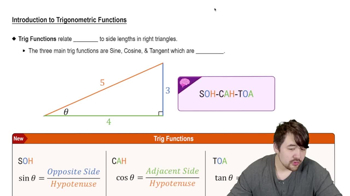
Introduction to Trigonometric Functions

Integral of a Function

The integral of a function represents the area under the curve of that function over a specified interval. In this context, evaluating the integral ∫[8√2 to 16] 1/√(x² - 64) dx involves finding the antiderivative of the integrand and then applying the Fundamental Theorem of Calculus to compute the definite integral. Understanding how to evaluate integrals is crucial for solving problems in calculus.
Video consigliato:
05:11
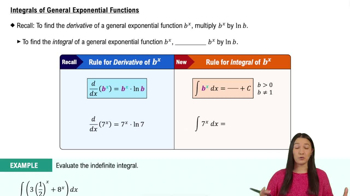
Integrals of General Exponential Functions

Definite Integral

A definite integral is an integral that computes the accumulation of quantities, such as area, over a specific interval [a, b]. It is represented as ∫[a to b] f(x) dx, where f(x) is the integrand. The result of a definite integral is a numerical value that reflects the total area between the curve and the x-axis from x = a to x = b. This concept is essential for applying limits and evaluating integrals in practical scenarios.
Video consigliato:
Percorso guidato
05:43
Definition of the Definite Integral